How to Choose an AI Model for Your API Workload in 2026
A practical decision framework for choosing the right AI API model by task difficulty, context, tools, latency, cost, privacy and deployment needs.
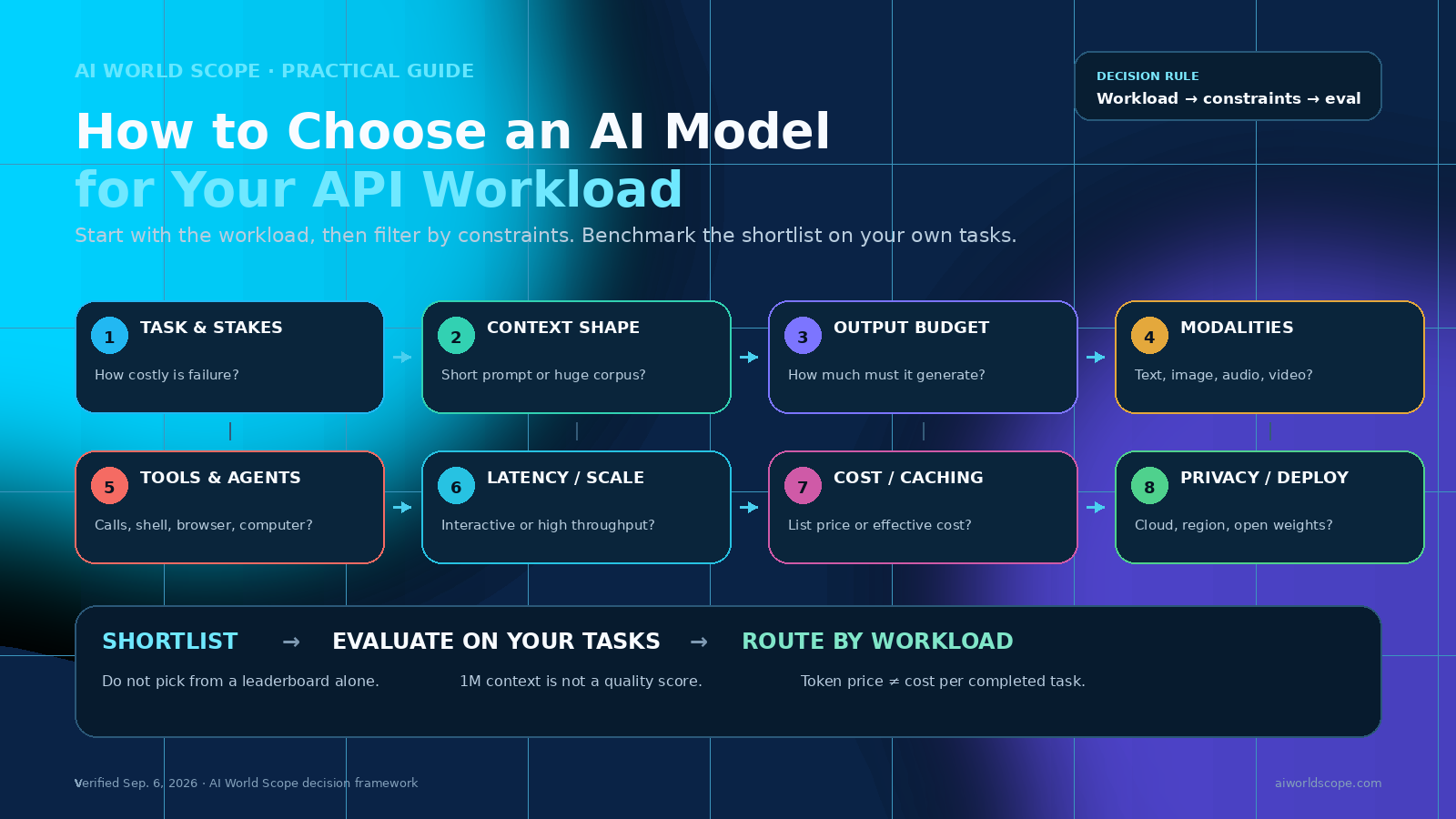
Summary
Choosing an AI model for an API workload is no longer a matter of finding the highest benchmark score. In 2026, the right choice depends on the shape of the workload: task difficulty, failure cost, context size, output length, modalities, tool use, latency, deployment constraints, and the economics of repeated production calls.
The most useful rule is simple:
Workload → constraints → shortlist → evaluate → route.
That order matters. Starting with a provider or leaderboard can lead to frontier-model prices for routine work or hidden long-context costs.
This guide gives a practical framework for narrowing the current model market into a small set worth testing. Pricing and model specifications were rechecked on September 6, 2026.
Quick Take
- Start with the workload and failure cost, not the provider.
- A 1M context window is a capacity limit, not a quality score.
- Tool support and agent reliability matter more as workflows become autonomous.
- Optimize cost per successful task, not price per token.
- For production, routing several models can be better than choosing one winner.
The decision rule: workload first, model second
The wrong sequence is:
brand → benchmark → price → production
A better sequence is:
task → constraints → shortlist → workload eval → routing policy
Why? Because models that look similar on paper can be designed for very different jobs.
GPT-6 Astra is positioned by OpenAI for the hardest end-to-end work and costs $10/$50 per million input/output tokens. GPT-5.6 Luna costs $0.20/$1.20 and is explicitly designed for cost-sensitive high-volume workloads. Both expose a 1.05M-token context window and broad tool support, but they are not substitutes for the same production role.
The same pattern appears across providers. Anthropic tells developers to start with Claude Opus 5 for most high-end workloads and move to Claude Fable 5.1 when Opus at higher effort still falls short. Google positions Gemini 3.8 Flash around long-horizon coding, agents and enterprise workflows while keeping its current introductory price at $0.75/$3.75.
The first decision, therefore, is not “Which model is best?” It is “What must this system reliably accomplish?”
Step 1 — Classify task difficulty and failure cost
Start by separating tasks into three practical tiers.
| Workload class | Typical examples | What matters most | Model strategy |
|---|---|---|---|
| Routine | extraction, tagging, classification, rewriting, routing | cost, latency, format reliability | start cheap |
| Professional | analysis, coding, research synthesis, document generation | quality/cost balance, tools, context | balanced frontier model |
| High-stakes / autonomous | complex agents, hard debugging, multi-step research, computer use | success rate, recovery, reasoning, tools | premium model first |
Failure cost is often more important than task length.
If a classification call is wrong, you may retry it or send it to a stronger fallback. If an autonomous agent is modifying production infrastructure, a failure can cost far more than the token bill.
That is why the rational model can change even when the prompt is identical.
For the hardest broad end-to-end work, GPT-6 Astra is a current premium starting point. For long-horizon agentic work, Claude Fable 5.1 is explicitly designed for that tier — but Anthropic itself says most workloads should begin with Claude Opus 5 and escalate only when needed.
That is a useful buying principle: premium capability should be earned by the workload, not assumed by default.
Step 2 — Measure the context you actually need
Context-window marketing has converged around very large numbers.
GPT-6 Astra, GPT-5.6 Terra and Luna expose 1.05M tokens. Claude Fable 5.1, Opus 5 and Sonnet 5 are in the 1M-token class. Gemini 3.8 Flash supports 1,048,576 input tokens. DeepSeek V4 Pro and V4 Flash list 1M context. Kimi K3 is also a 1M-context model.
That does not mean they are equivalent.
A context window tells you how much can fit into a request. It does not prove that the model will retrieve every fact equally well, reason equally well across the whole window, or cost the same when the prompt becomes enormous.
Two pricing traps are especially important:
| Provider/model | Long-context rule |
|---|---|
| GPT-6 Astra / GPT-5.6 family | Above 272K input tokens, the full request uses 2× input/cache rates and 1.5× output pricing |
| Grok 4.6 | At 200K prompt tokens or more, rates rise from $2/$6 to $4/$12 |
| Claude 4.6+ family | Anthropic says the full 1M context is available at standard per-token rates |
| DeepSeek V4 | Price depends on peak vs off-peak time rather than a long-context surcharge |
For large-document or repository workloads, measure normal prompt size, 95th-percentile prompt size and maximum expected prompt size. A model that is cheaper at 50K tokens may become less attractive at 300K.
Also ask whether you need to send everything. Retrieval, compaction and caching can reduce context pressure.
Step 3 — Budget output, not just input
Many API cost estimates look only at input tokens.
That is a mistake for reasoning models and agents.
Output can include the final response, thinking/reasoning tokens where billed, tool-call arguments, code, structured data and repeated agent turns. Long-horizon models can generate dramatically more output than a simple classifier.
Anthropic notes that Fable 5.1's stronger agentic behavior can use more output tokens even though its cache-read price fell sharply. Claude Sonnet 5 also uses a newer tokenizer, so Anthropic warns that the same text can produce more tokens than on Sonnet 4.6.
The practical rule is: estimate tokens per completed task, not tokens per request. A cheaper model can lose if it needs repeated retries.
Step 4 — Filter by modalities before comparing intelligence
If your system needs more than text, eliminate incompatible models early.
Gemini 3.8 Flash accepts text, images, video, audio and PDF input. It also supports code execution, function calling, file search, search grounding and computer use in preview.
GPT-6 Astra and the GPT-5.6 family accept text and image input and expose a broad Responses API tool surface, including web search, file search, code interpreter, hosted shell, computer use and MCP.
Claude Fable 5.1, Opus 5 and Sonnet 5 accept text and image input and output text, with tool/platform support depending on the model and deployment environment.
If your application processes calls, video, PDFs or screenshots, modality support can shrink the shortlist faster than benchmarks do.
Step 5 — Treat tools and agents as part of the model system
For an agent, the “model” is only one component.
The full system includes:
model + prompt + context manager + tool schema + execution loop + retry policy + permissions + sandbox
A model that is excellent at standalone reasoning can still underperform if its tool loop is unreliable in your harness.
That is especially relevant now that major models expose overlapping agent capabilities. OpenAI's current models support function calling and hosted tools. Gemini 3.8 Flash includes function calling, code execution, search and computer use preview. DeepSeek V4 supports tool calls and both OpenAI-compatible and Anthropic-compatible API surfaces. Grok 4.6 supports function calling, web/X search and code execution.
For autonomous workflows, evaluate tool selection, argument accuracy, recovery, state preservation, permission boundaries, loop termination and cost growth.
If the model will be allowed to act, not merely answer, these tests matter more than a static reasoning score.
Step 6 — Decide where latency sits in the trade-off
A human waiting for autocomplete has a different requirement from an overnight research agent.
For interactive systems, first-token latency and generation speed can dominate user experience. For asynchronous work, quality and cost per successful job can matter more.
Gemini 3.8 Flash is particularly relevant here. Google positions it as a Flash-class production model, and independent Artificial Analysis testing describes it as notably fast while retaining strong current capability for its price.
Claude Sonnet 5 is Anthropic's “speed and intelligence” balance. GPT-5.6 Terra is OpenAI's explicit intelligence/cost balance. Grok 4.6 sits at a moderate token price for coding and agentic work when prompts stay below its 200K long-context threshold.
Set an actual service objective: response latency for chat, completion time for agents, throughput per dollar for batch work, and p95 latency/error rate for customer-facing systems. Without a target, “fast” has no operational meaning.
Step 7 — Calculate cost per successful task
Here is a deliberately simple example.
Assume one request uses 100K uncached input tokens and 5K output tokens, with no tool fees, cache benefits, retries or extra long-context pricing.
| Model | Approx. list-rate cost for that request |
|---|---|
| GPT-5.6 Luna | $0.026 |
| DeepSeek V4 Pro — off-peak | $0.076 |
| Gemini 3.8 Flash — current promo | $0.094 |
| Grok 4.6 | $0.230 |
| Claude Sonnet 5 | $0.250 |
| GPT-5.6 Terra | $0.260 |
| Claude Opus 5 | $0.625 |
| GPT-6 Astra / Claude Fable 5.1 | $1.250 |
This table is not a quality ranking.
It shows why routing matters. If Luna solves a routine job reliably, using Astra can be wasteful. If Luna fails repeatedly on a complex task and Astra succeeds once, the economics can reverse.
For a deeper price breakdown, see Cheapest AI APIs in 2026: Price vs Capability and the live AI World Scope Price Tracker.
Step 8 — Apply privacy, deployment and control constraints
Sometimes the model choice is decided before quality testing begins.
Your organization may require:
- a specific cloud or region
- zero-data-retention terms
- private networking
- self-hosting
- open weights
- a specific license
- a vendor already approved by procurement
- data-residency or sector-specific controls
If self-hosting or weight access is a hard requirement, proprietary APIs leave the shortlist.
Kimi K3 is one current open-weight frontier option with a 1M context window and official weights available through Hugging Face. But its 2.8T-parameter scale makes infrastructure planning non-trivial. “Open weights” does not automatically mean “cheap to run.”
Likewise, a cloud API does not automatically mean weak privacy. Deployment architecture, enterprise terms, retention controls and where the model is hosted all matter.
Filter on these requirements before spending time benchmarking models you cannot legally or operationally deploy.
A practical 2026 starting map
The table below is a shortlist generator, not a permanent ranking.
| Workload | Models worth starting with | Why |
|---|---|---|
| Hardest broad end-to-end work | GPT-6 Astra | OpenAI's top current model; broad tools and computer use |
| Long-horizon autonomous work | Claude Fable 5.1 | Designed for demanding long-running agents; premium price |
| Premium general professional work | Claude Opus 5, GPT-5.6 Sol | Strong high-end capability without the top premium tier |
| Balanced professional API | Claude Sonnet 5, GPT-5.6 Terra | Lower cost with broad capability/tool support |
| Fast multimodal / high throughput | Gemini 3.8 Flash | Audio/video/PDF inputs, tools, aggressive current pricing |
| Very cost-sensitive high volume | GPT-5.6 Luna, DeepSeek V4 Flash | Extremely low token economics |
| Cheap reasoning / background agents | DeepSeek V4 Pro | 1M context, tools, peak/off-peak economics |
| Coding / agent alternative | Grok 4.6 | $2/$6 below 200K prompts, tools, 500K context |
| Regional / full-stack alternative | Qwen3.8-Max | 1M context, multimodal input, tool support, regional pricing |
| Open-weight control | Kimi K3 | 1M context and released weights |
For coding specifically, use the deeper Best AI Models for Coding in 2026 guide rather than treating this table as a coding leaderboard.
How to run a model evaluation that actually helps
Once constraints reduce the field to two to four models, build a small evaluation set from your own production work.
A useful first pass can be 20–50 representative tasks.
For each task, record:
- whether the result passed
- number of retries
- end-to-end latency
- total input/output/cache tokens
- tool-call failures
- human correction time
- estimated cost per successful completion
Do not change five things at once. Keep the prompt, tool definitions and scoring method as consistent as practical.
Then segment results by task type.
A model can lose the overall average while clearly winning one important workload. That is exactly when routing becomes useful.
Why benchmark rankings should be treated as evidence, not law
Benchmarks are valuable, but their meaning depends on the harness, effort level and benchmark version.
Artificial Analysis updated its Intelligence Index to v4.2 on September 4, adding more realistic agentic knowledge-work and long-document tasks. That kind of methodology change can shift absolute scores and rankings without any model itself changing.
Agent benchmarks are even more system-sensitive because the result can depend on the coding agent, tool loop and configuration surrounding the model.
Use public benchmarks to create a shortlist and identify strengths.
Use your own workload eval to make the production decision.
The architecture that often wins: model routing
The best production answer may be several models.
A simple routing architecture can look like this:
routine request → low-cost model
uncertain / difficult request → balanced model
high-value or failed request → premium model
That can be extended with modality, context size, latency and privacy rules.
For example, a system might send bulk extraction to Luna or DeepSeek, multimodal document work to Gemini 3.8 Flash, general professional work to Sonnet 5 or Terra, and only escalate the hardest jobs to Astra, Opus or Fable 5.1.
Routing adds engineering complexity, but at scale it can align model spend with task difficulty better than a one-model policy.
A five-question final checklist
Before committing to a model, you should be able to answer:
- What does success look like on our real tasks?
- What is the p95 context and output size?
- Which tools, modalities and deployment constraints are mandatory?
- What is the cost per successful task, including retries and caching?
- What is our fallback when the first model fails?
If those answers are clear, model selection becomes a measurable engineering decision instead of a brand preference.
What to watch next
This market moves too quickly for a static recommendation to remain correct indefinitely.
Gemini 3.8 Flash's current introductory pricing is scheduled to change on January 1, 2027. OpenAI and other providers can change pricing, model availability and tool behavior. New model snapshots can also shift the quality frontier without changing the product category.
Re-evaluate when:
- a major model launches
- pricing changes materially
- your workload mix changes
- context sizes grow
- tool use becomes more autonomous
- a provider changes retention/deployment terms
- your own eval pass rate drifts
AI World Scope Take
The model market is becoming too broad for a universal winner.
That is good news for buyers.
You no longer need the most expensive model for every call. Cheap models are increasingly capable, fast models can handle serious agent workflows, premium models can be reserved for the jobs where failure is expensive, and open-weight models provide another path when control matters.
The competitive advantage is moving from “Which model did we choose?” to “How intelligently do we choose and route models for each workload?”
That is the durable skill.
Sources & Documentation
Sources used for this article, with source type and publisher shown where available.
- documentationGPT-6 Astra model documentationVisit Source
- documentationOpenAI model guidanceVisit Source
- documentationGPT-5.6 Terra model documentationVisit Source
- documentationGPT-5.6 Luna model documentationVisit Source
- documentationClaude Fable 5.1 model overviewVisit Source
- documentationWhat's new in Claude Opus 5Visit Source
- documentationWhat's new in Claude Sonnet 5Visit Source
- documentationGemini 3.8 Flash model documentationVisit Source
- documentationGemini Developer API pricingVisit Source
- officialDeepSeek V4 Pro GA releaseVisit Source
- documentationDeepSeek models and pricingVisit Source
- documentationGrok 4.6 model documentationVisit Source
- documentationSpaceXAI API pricingVisit Source
- documentationQwen3.8-Max model informationVisit Source
- officialKimi K3 technical blog and API pricingVisit Source
- documentationKimi K3 weights and model cardVisit Source
- newsArtificial Analysis Intelligence Index v4.2 methodology updateVisit Source
- newsArtificial Analysis: Claude Fable 5.1Visit Source
- newsArtificial Analysis: Benchmarking GPT-6 AstraVisit Source
- newsArtificial Analysis: Gemini 3.8 FlashVisit Source