Best AI Models for Coding in 2026: The Right Model for Every Workload
An evidence-backed guide to the best AI coding models in 2026, updated for Claude Fable 5.1 and Gemini 3.8 Flash with workload-specific picks for agents, repositories, web apps, open weights and budget APIs.
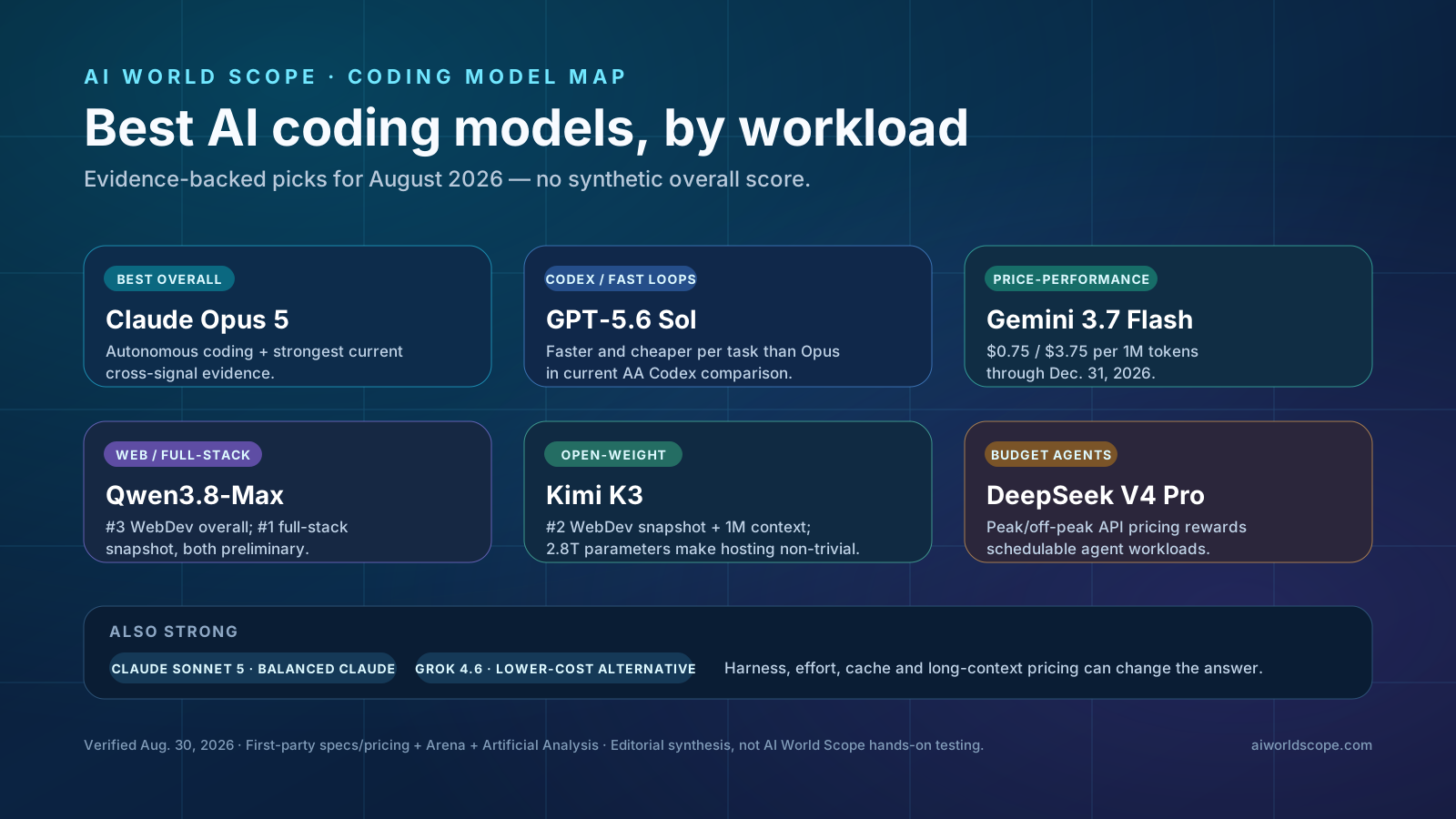
Summary
Two major releases have changed the AI coding landscape since this guide was first published. Anthropic released Claude Fable 5.1 on September 1, and Google followed with Gemini 3.8 Flash on September 2.
The update does not make every previous recommendation obsolete. Claude Opus 5 remains our best default for teams that want a mature, quality-first coding model with strong evidence across multiple independent signals and materially lower token pricing than Fable 5.1. But Fable 5.1 is now the strongest option to test when the task is genuinely long-horizon and difficult, while Gemini 3.8 Flash becomes the most interesting fast, low-priced challenger for high-volume agentic coding.
The important distinction is evidence maturity. Fable 5.1 and Gemini 3.8 Flash already have strong early independent results from Artificial Analysis, but they have not yet accumulated the same breadth of human-preference and multi-harness evidence as older models. We therefore separate best default, highest ceiling, and best price-performance instead of forcing one universal winner.
Quick Take
- Best default overall: Claude Opus 5 — mature cross-signal evidence, 1M context, and half Fable 5.1's headline token price.
- Highest ceiling for long-horizon coding: Claude Fable 5.1 — new independent results put it at the frontier, but it costs $10/$50 per 1M tokens.
- Best for Codex / terminal loops: GPT-5.6 Sol — still the strongest fit when OpenAI's agent stack and fast repository workflows are central.
- Best fast agentic value: Gemini 3.8 Flash — $0.75/$3.75 introductory pricing, 1M context, and stronger independent intelligence than 3.7 Flash.
- Efficiency-first Flash option: Gemini 3.7 Flash — still relevant when lower total token consumption matters more than 3.8's higher ceiling.
Our winners by coding workload
| Coding workload | AI World Scope pick | Why it stands out | Main caveat |
|---|---|---|---|
| Best default overall coding | Claude Opus 5 | Strong mature evidence across coding agents and human-preference signals at $5/$25 | Newer Fable 5.1 now has a higher measured ceiling in early independent testing |
| Hardest long-running autonomous work | Claude Fable 5.1 | Frontier independent results, 1M context, 128K output, long-horizon agent focus | $10/$50 base pricing; slower; some independent evaluation output used Anthropic safety fallback |
| Codex / terminal / repo loops | GPT-5.6 Sol | Strong fit for Codex, shell tools, repositories and rapid agent loops | Long prompts above 272K trigger higher token rates |
| Fast agentic price-performance | Gemini 3.8 Flash | 59 on Artificial Analysis Intelligence Index at high effort, very high measured speed, $0.75/$3.75 headline price | Uses more output tokens than 3.7 in current evaluation, raising cost per task |
| Efficiency-first Flash workloads | Gemini 3.7 Flash | Same headline token price and lower measured task cost in the current AA comparison | Lower measured intelligence than 3.8 Flash |
| Web and full-stack value | Qwen3.8-Max | Strong August WebDev evidence and competitive international API pricing | Arena positions can move and some views were preliminary |
| Open-weight / reference-driven web coding | Kimi K3 | Strong WebDev human-preference evidence with open weights and 1M context | 2.8T-class scale makes self-hosting demanding |
| Ultra-budget schedulable agents | DeepSeek V4 Pro | Off-peak pricing can make background agent work exceptionally cheap | Peak pricing doubles the off-peak rates |
| Balanced Claude default | Claude Sonnet 5 | Claude ecosystem at $2/$10 with 1M context | Lower ceiling than Opus and Fable |
| Lower-cost proprietary alternative | Grok 4.6 | Competitive short-context pricing and broad tools | Price doubles at or above 200K prompt tokens |
How we evaluated the models
We deliberately do not create a synthetic 0–100 AI World Scope score. Coding-model rankings are unusually sensitive to the agent harness, reasoning effort, token budget, tool configuration, cache behavior, and benchmark design.
This update uses four evidence layers:
- Hard specifications: current API pricing, context windows, output limits, availability, tool support and pricing conditions from first-party documentation.
- Independent model and agent evaluations: especially Artificial Analysis and Terminal-Bench-related evidence.
- Human preference for web coding: Arena's WebDev leaderboard, where the latest comparable snapshot still predates Fable 5.1 and Gemini 3.8 Flash.
- Provider evaluations and positioning: useful for understanding intended workloads, but labeled as provider-reported rather than independent proof.
AI World Scope has not performed a proprietary hands-on benchmark for this guide. Our recommendations are an editorial synthesis of the evidence available as of September 2, 2026.
Why this matters: a new model can lead one benchmark on launch day without being the best default for every developer. Evidence breadth, harness fit, task economics and operational maturity all matter.
1. Claude Opus 5 — Best default overall coding model
Claude Opus 5 remains our default quality-first recommendation, even after the arrival of Fable 5.1.
That may sound counterintuitive because Fable 5.1 now posts stronger early results. The reason is practical: Opus 5 already has mature evidence across different coding signals, a 1M-token context window and 128K maximum output, while its base API price is $5 input / $25 output per 1M tokens — half Fable 5.1's headline rate.
Arena's August 21 WebDev snapshot placed Opus 5 at max effort #1 overall, ahead of Kimi K3 and Qwen3.8-Max. Artificial Analysis also previously placed Opus at the top tier of coding-agent and general intelligence evaluations.
Anthropic's own Fable 5.1 documentation reinforces the distinction rather than eliminating it: for most workloads, Anthropic recommends starting with Opus 5 and moving to Fable 5.1 when higher-effort Opus evaluations still fall short.
Choose Opus 5 when: you want a proven premium default for autonomous coding, large refactors and mixed coding-and-reasoning work without paying Fable pricing on every task.
2. Claude Fable 5.1 — Highest ceiling for long-horizon coding
Claude Fable 5.1 replaces Fable 5 as our specialist pick for the hardest, longest-running autonomous engineering work.
Anthropic lists 1M context, 128K maximum output, always-on adaptive thinking, and $10/$50 per 1M input/output tokens. The base token price is unchanged from Fable 5, but cache reads fell from $1 to $0.25 per 1M tokens. Anthropic estimates that can reduce typical workload cost by around 25% and highly agentic workload cost by up to roughly 45%.
The early independent signal is substantial. Artificial Analysis reports Fable 5.1 at max effort scoring 66 on its Intelligence Index, ahead of Opus 5 at 63 in that evaluation. It also reports 91.4% on Terminal-Bench v2.1, the highest score it had measured at publication time.
There is an important methodology caveat. Artificial Analysis says its evaluation used Anthropic's production safety fallback, and roughly 4% of output tokens were served by fallback models when safeguards triggered. That does not invalidate the result, but it means the score should not be treated as a perfectly isolated measurement of Fable 5.1 alone.
Fable 5.1 also spans a wide range of reasoning effort and token consumption. The maximum setting is not automatically the economical choice.
Choose Fable 5.1 when: the task is a multi-hour or multi-day autonomous project where failure costs more than the premium and your own evaluation shows Opus 5 is not enough.
3. GPT-5.6 Sol — Best for Codex and fast repository loops
GPT-5.6 Sol remains our strongest fit when the workflow is centered on Codex, shell tools, repositories and rapid agent loops.
OpenAI positions Sol as its flagship model for complex reasoning and coding. The API exposes a 1.05M-token context window, 128K maximum output, function calling and a broad set of hosted tools.
Artificial Analysis' current Codex comparison evaluates the whole agent system, not only the model. In the evidence used for the original version of this guide, GPT-5.6 Sol at max effort scored strongly on coding-agent evaluations while maintaining fast task completion.
The current API price is $4 input / $20 output per 1M tokens, promotional at least through November 21, 2026. Above 272K input tokens, OpenAI prices the full request at 2× input and 1.5× output.
Choose Sol when: Codex, terminal speed and OpenAI's tool ecosystem are central to the workflow.
4. Gemini 3.8 Flash — Best fast agentic value
Gemini 3.8 Flash changes the value conversation because Google kept the same introductory headline token price as Gemini 3.7 Flash while raising the model's measured intelligence.
Google prices 3.8 Flash at $0.75 input / $3.75 output per 1M tokens through December 31, 2026. The model supports 1,048,576 input tokens, up to 65,536 output tokens, multimodal inputs, code execution, file search, function calling, search grounding and computer use in preview.
Google describes it as its most intelligent Flash model, engineered for long-horizon software engineering and autonomous agents. Artificial Analysis provides a useful independent check: at high reasoning, Gemini 3.8 Flash scores 59 on its Intelligence Index, up from 56 for 3.7 Flash, and reaches the Intelligence-versus-Cost-per-Task Pareto frontier.
Speed remains a major advantage. Artificial Analysis measured roughly 305 output tokens per second in its current model profile.
But there is a crucial catch: 3.8 Flash used about 30% more output tokens per task than 3.7 Flash in the Artificial Analysis evaluation, and its measured cost per task was about 40% higher, at roughly $0.58. The per-token price did not change; the model simply worked harder.
That makes 3.8 Flash a stronger model, but not automatically a cheaper model for every workload.
Choose Gemini 3.8 Flash when: you want a fast, capable agentic model at low headline token rates and the extra reasoning improves completion quality enough to justify additional token use.
5. Gemini 3.7 Flash — Still relevant for efficiency-first workloads
Gemini 3.7 Flash should not disappear from the guide simply because 3.8 exists.
Both models currently share the same introductory $0.75/$3.75 headline rates. In Artificial Analysis' current comparison, 3.7 scored lower on intelligence but consumed fewer output tokens and therefore had lower measured task cost.
That creates a real production choice:
- 3.8 Flash: higher measured intelligence and stronger new coding/agent capability.
- 3.7 Flash: lower reasoning/output consumption can still win when the workload does not benefit from 3.8's extra effort.
This is exactly why price-per-million-token tables are becoming less useful on their own.
Choose 3.7 Flash when: the task is predictable, high-volume, and your own evaluation shows 3.8's additional reasoning does not improve completion rates enough to pay for itself.
6. Qwen3.8-Max — Best web/full-stack value
On Arena's August 21 WebDev snapshot, Qwen3.8-Max ranked #3 overall and #1 on the full-stack view, ahead of Opus 5 in that particular slice. Its positions were marked preliminary, so they should be treated as strong evidence rather than a permanent ranking.
The model supports a 1M context window, up to 131,072 output tokens, text/image/video input, function calling and hybrid thinking. Alibaba Cloud's international price is $2 input / $6 output per 1M tokens; regional rates vary.
The key limitation of this section is timing: the WebDev snapshot predates Fable 5.1 and Gemini 3.8 Flash. Until comparable human-preference data includes the new releases, Qwen remains our web/full-stack value pick rather than a claim that it beats the newcomers.
Choose Qwen3.8-Max when: full-stack applications and web products are the priority and you want strong current web-coding evidence at a moderate token price.
7. Kimi K3 — Best open-weight coding model
Kimi K3 remains our open-weight coding pick.
In the August 21 WebDev snapshot, Kimi K3 ranked #2 overall and #1 in reference-based design. Moonshot also positions K3 for long-horizon coding and large codebases.
The model has a 1M-token context window and a very large 2.8T-parameter architecture. The official API price is $3 per 1M cache-miss input tokens, $0.30 for cache-hit input, and $15 output.
Its scale is also the caveat: a 2.8T-class model is not a casual self-hosting project. For many developers, the official API or Kimi Code is more practical.
Choose Kimi K3 when: open weights, reference-driven web coding or large-codebase work matter.
8. DeepSeek V4 Pro — Best ultra-budget model for schedulable agents
DeepSeek V4 Pro remains the most interesting option for teams that can optimize around time-of-day pricing.
For V4 Pro, cache-miss input/output rates are $0.66/$1.98 off-peak and $1.32/$3.96 at peak. The model supports 1M context and up to 384K output.
DeepSeek's August release reported strong agent results, while Arena placed it below the top web-generation tier. Its advantage is economics.
Choose DeepSeek V4 Pro when: background agents, CI helpers or batch refactoring can be shifted into off-peak windows.
9. Claude Sonnet 5 — Best balanced Claude option
Sonnet 5 remains a strong balanced default inside the Claude ecosystem.
Anthropic made its $2/$10 pricing permanent. It sits in the same broad 1M-context class as Opus and Fable while targeting coding, agents and professional work at scale.
It does not have Fable 5.1's frontier ceiling or Opus 5's quality-first positioning, but its price makes it easier to deploy broadly.
Choose Sonnet 5 when: you want Claude Code and Anthropic tooling at materially lower cost than Opus or Fable.
10. Grok 4.6 — A strong lower-cost proprietary alternative
Grok 4.6 remains worth keeping on the shortlist. SpaceXAI positions it directly for coding and agentic tasks, and Arena's August WebDev snapshot placed it #5 overall.
The standard rate below 200K prompt tokens is $2 input / $6 output per 1M tokens, with a 500K context window and function calling, web search, code execution and configurable reasoning.
The caveat is long-context pricing: at 200K prompt tokens or more, rates rise to $4 input / $12 output.
Grok fits teams that want a capable proprietary alternative at competitive short-context prices; its economics become less distinctive on very large repositories.
The pricing table developers should actually use
| Model | Input / 1M | Output / 1M | Context | Important pricing condition |
|---|---|---|---|---|
| Claude Opus 5 | $5 | $25 | 1M | Prompt caching available |
| Claude Fable 5.1 | $10 | $50 | 1M | Cache reads $0.25/M; 50% Batch discount |
| GPT-5.6 Sol | $4 | $20 | 1.05M | >272K input: 2× input, 1.5× output |
| Gemini 3.8 Flash | $0.75 | $3.75 | 1,048,576 | Intro price through Dec. 31, 2026; higher effort can use more tokens |
| Gemini 3.7 Flash | $0.75 | $3.75 | 1M | Same intro headline price; lower measured task cost than 3.8 in current AA eval |
| Qwen3.8-Max | $2 | $6 | 1M | International rate; regional pricing varies |
| Kimi K3 | $3 cache miss | $15 | 1M | Cache-hit input $0.30 |
| DeepSeek V4 Pro | $0.66–$1.32 | $1.98–$3.96 | 1M | Off-peak vs peak |
| Claude Sonnet 5 | $2 | $10 | 1M | $2/$10 is current standard price |
| Grok 4.6 | $2 | $6 | 500K | ≥200K prompt: $4/$12 |
A model that costs more per token can still be cheaper per completed task if it needs fewer attempts. The reverse is also true: a model with the same token price can cost more if it reasons longer.
The most important new metric: cost per completed task
Gemini 3.8 Flash makes the weakness of sticker-price comparisons unusually clear.
Google kept 3.8 at the same introductory token rates as 3.7, yet Artificial Analysis measured roughly 40% higher cost per task because the new model generated more tokens and took more agentic steps.
Fable 5.1 shows the opposite side of the equation. Its base $10/$50 price did not fall, but dramatically cheaper cache reads can lower effective cost for long-running agents that repeatedly reuse large contexts.
The practical metric is therefore:
total cost of a successful task = token price × tokens consumed × attempts + tool/runtime overhead
That is why routing should be based on your own workload rather than a single price column.
How to choose without overfitting to benchmarks
Start with the workload rather than the provider.
For long repository migrations, prioritize reliability, long-horizon behavior, tool use and recovery from mistakes. For web generation, human preference and design adherence matter more. For CI and batch agents, cost per completed task and throughput may dominate.
And 1M context is not a quality score. Many candidates sit in the same context class while differing sharply in reasoning behavior, output limits, pricing and agent ecosystems.
A useful evaluation stack is:
- run a representative set of your own tasks;
- measure completion rate, not just pass/fail on first attempt;
- record tokens, wall-clock time and tool calls;
- separate easy, medium and hard work;
- compare the cheapest model that reliably clears each quality threshold.
What we would choose today
If we were selecting models for a new coding stack on September 2, 2026:
- Start with Claude Opus 5 as the premium default when quality is the first priority.
- Test Claude Fable 5.1 for the hardest autonomous work and escalate only when its additional capability beats Opus on your own evaluations.
- Use GPT-5.6 Sol when Codex and fast terminal/repository loops are central.
- Test Gemini 3.8 Flash as the default high-volume agentic value model, but compare total task cost directly against 3.7 Flash.
- Keep Gemini 3.7 Flash for efficiency-first workloads where 3.8's extra effort is unnecessary.
- Test Qwen3.8-Max for full-stack and product-building workloads.
- Use Kimi K3 when open weights or reference-driven web coding matter.
- Consider DeepSeek V4 Pro for schedulable background agents where cost is critical.
- Use Claude Sonnet 5 when the Claude ecosystem matters but premium-model economics do not.
What to watch next
The biggest near-term signal is independent evidence breadth for the two new releases.
Fable 5.1 already leads several Artificial Analysis measurements, but the evaluation's safety-fallback behavior needs to be remembered and fresh human-preference data will matter. Gemini 3.8 Flash has a strong early intelligence/cost position, but its higher token consumption means production teams should watch task-level economics rather than assume “same price” means “same bill.”
The other time-sensitive trigger remains January 1, 2027, when Google's published standard Gemini 3.8 Flash input/output rates rise to $1.50/$7.50 unless Google changes the schedule.
AI World Scope Take
The September releases make the coding-model market more interesting, not simpler.
Claude Fable 5.1 raises the capability ceiling. Gemini 3.8 Flash raises the amount of intelligence available at Flash pricing. Neither eliminates the need for model routing.
Opus 5 still makes sense as a mature premium default. Fable 5.1 is the escalation path for the hardest long-horizon work. Sol remains compelling when Codex is the product surface. Gemini 3.8 is a powerful low-priced agentic candidate, while 3.7 can still win on efficiency. Qwen and Kimi remain differentiated by web-coding and openness, and DeepSeek remains difficult to beat for schedulable economics.
The best coding stack in 2026 is increasingly a portfolio of models matched to task difficulty, harness, latency and cost per completed task — not a single winner.
Sources & Documentation
Sources used for this article, with source type and publisher shown where available.
- officialClaude Opus 5 releaseVisit Source
- documentationClaude Fable 5.1 model documentationVisit Source
- officialClaude Fable 5.1 product and launch pageVisit Source
- documentationClaude Platform pricingVisit Source
- officialClaude Sonnet 5 releaseVisit Source
- documentationGPT-5.6 Sol model documentationVisit Source
- officialGPT-5.6 launch and pricing updatesVisit Source
- documentationGemini 3.8 Flash model documentationVisit Source
- officialIntroducing Gemini 3.8 Flash and 3.8 Flash CyberVisit Source
- documentationGemini 3.8 Flash model cardVisit Source
- documentationGemini Developer API pricingVisit Source
- officialKimi K3 technical blogVisit Source
- documentationQwen3.8-Max model informationVisit Source
- officialDeepSeek V4 Pro GA releaseVisit Source
- documentationDeepSeek models and pricingVisit Source
- documentationGrok 4.6 model documentationVisit Source
- newsWebDev Arena overall leaderboard — Aug. 21, 2026Visit Source
- newsWebDev Arena full-stack leaderboard — Aug. 21, 2026Visit Source
- newsWebDev Arena reference-based design leaderboard — Aug. 21, 2026Visit Source
- newsArtificial Analysis: Claude Fable 5.1Visit Source
- newsArtificial Analysis: Gemini 3.8 FlashVisit Source
- newsArtificial Analysis: Opus 5Visit Source
- newsArtificial Analysis: GPT-5.6 benchmarksVisit Source
- documentationTerminal-Bench 2.1 official leaderboardVisit Source