Google Unveils Gemini 4 Argon, Its New Frontier Model, With a 1M-Token Output Limit
Google has unveiled Gemini 4 Argon, a frontier model with a 1 million-token output limit, introductory $2/$10 API pricing, and an initial rollout limited to trusted cyber defenders.
Summary
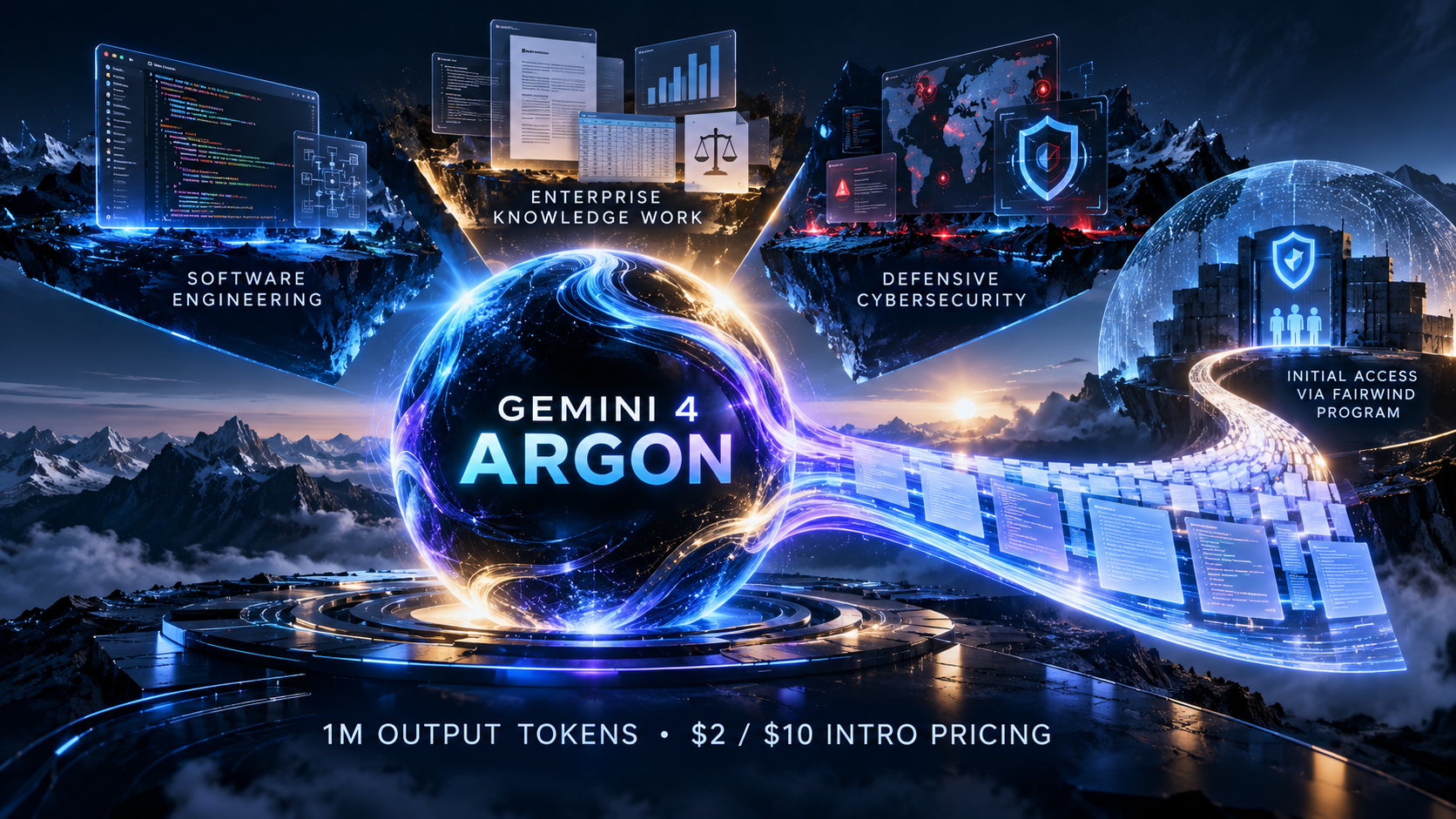
Google unveiled Gemini 4 Argon on September 30, its new frontier model for long-horizon software engineering, enterprise knowledge work, and cybersecurity defense.
Argon expands the maximum output limit to 1 million tokens, up from 64,000 on earlier Gemini models. Google says the model will launch at an introductory API price of $2 per million input tokens and $10 per million output tokens, with cached input priced at a 95% discount.
There is an important catch: this is not yet a broad public release. Argon is initially rolling out to trusted cybersecurity defenders through Google's Fairwind Program while Google participates in a U.S. government pre-release access process and continues testing safeguards.
Quick Take
- Gemini 4 Argon is Google's new frontier model, announced September 30.
- It supports up to 1 million output tokens, a major increase from the previous 64K limit.
- Google lists introductory pricing of $2/M input and $10/M output, with cached input 95% cheaper than standard input.
- Initial access is restricted to trusted cyber defenders through Fairwind; Google has not given a public release date.
- Google's benchmark results are company-reported and mixed: Argon leads some disclosed evaluations but trails rivals on others.
What Google announced
Google describes Argon as a model built to sustain deep reasoning across long, complex workflows rather than simply answer individual prompts.
The company says thousands of Googlers are already using it internally for specialized coding, deeper research, and writing. Google also described internal projects in which Argon agents helped optimize quantum algorithms, identify data-center memory savings, and migrate large C/C++ codebases toward Rust.
Those examples are Google-reported internal results, not independent AI World Scope testing.
The clearest specification change is output length. Google says Argon can generate as many as 1 million tokens in a single trajectory, giving the model much more room for extended reasoning, large code changes, and long-form professional work.
Original-value analysis: 1M output tokens change the failure mode, not just the ceiling
A 1 million-token output limit sounds primarily like a capacity upgrade. Operationally, it changes something more important: how much work a model can attempt before a human checkpoint.
For a large code migration or multi-stage research task, fewer forced handoffs can preserve context and reduce orchestration overhead. But extremely long autonomous trajectories also increase the amount of work that may need to be reviewed if the model makes an early incorrect assumption.
That makes output length a trade-off rather than an automatic quality advantage.
| Argon design choice | Potential benefit | Operational question |
|---|---|---|
| 1M-token output limit | Longer uninterrupted workflows | How much output can humans realistically review? |
| Long-horizon reasoning | Fewer manual task splits | Does error compound over long trajectories? |
| Agentic coding | Larger migrations and fixes | What automated verification catches regressions? |
| Cyber capability | Faster vulnerability discovery and patching | Which capabilities should remain access-controlled? |
For production teams, the useful metric will not be “maximum tokens generated.” It will be verified useful work per trajectory.
Pricing: aggressive on paper, unavailable to most buyers for now
Google says Argon will launch at an introductory rate of $2 per million input tokens and $10 per million output tokens, with 95% off the input-token rate for cached input. At those introductory rates, cached input works out to $0.10 per million tokens.
The pricing is notable because it places Google's new frontier model at a rate comparable to current mid-tier offerings while Google positions Argon against the highest-capability systems from OpenAI and Anthropic.
However, the price comparison is partly theoretical today. Most developers cannot yet call Argon through a generally available API.
Original-value analysis: availability-adjusted pricing matters more than the headline rate
A cheap frontier rate has no production value if a team cannot access the model.
That creates two distinct comparisons. Today, Argon is primarily a capability signal and controlled-access model for selected defenders. After broader release, its published pricing could put substantial pressure on frontier-model economics if Google preserves the introductory rate or remains below competing high-end models.
Teams should therefore avoid treating the announced price as an immediately actionable migration opportunity. The next material event is broad API availability, not another benchmark point.
Benchmarks: strong claims, with important caveats
Google reports that Argon reaches 77.9% on DeepSWE v1.1, an evaluation focused on long-horizon software engineering, and 91.7% on LVBench for long-video understanding.
The company also presents strong results across enterprise knowledge-work and cybersecurity evaluations.
These are vendor-reported results. Reuters notes that while Google's release shows Argon outperforming OpenAI's Astra and Anthropic's Opus on several benchmarks, Argon remains behind on other metrics, including two of the four coding-related benchmarks Google disclosed.
That mixed result is more informative than a single “benchmark winner” label. Argon's positioning appears strongest around sustained professional workflows, multimodal knowledge work, and cyber defense rather than universal dominance.
Why cybersecurity gets access first
Google says Argon can autonomously find, validate, and patch critical software vulnerabilities.
Trusted defenders in the Fairwind Program will receive access without the cyber guardrails intended for broader users. Google says it is simultaneously strengthening safeguards around cyber misuse, model exfiltration, alignment monitoring, and prompt-injection attacks before a wider release.
Google is also participating in the U.S. government's voluntary pre-release model-access process.
The sequencing is unusual but logical: the users most able to benefit from unrestricted defensive capability are also a smaller and more controlled population in which Google can test the model before general availability.
Gemini 3.5 Pro is no longer coming
Reuters reports that Google no longer plans to release Gemini 3.5 Pro, which had previously been expected earlier in 2026.
That makes Argon more than another model release. It effectively resets Google's top-tier roadmap around the Gemini 4 generation after a longer gap in the company's flagship lineup.
Google says Argon is larger than its previous Pro-class models. It has not publicly disclosed the model's parameter count.
Who should care now
Cybersecurity teams in Google's trusted-access programs have the most immediate reason to evaluate Argon.
Developers and enterprises should watch the model closely but should not plan a production migration until Google publishes broader access details and stable commercial terms.
AI infrastructure buyers should pay attention to the pricing signal. If a broadly available frontier model arrives near the announced introductory economics, competitors may face pressure to justify higher per-token rates through reliability, capability, or ecosystem advantages.
AI World Scope take
Gemini 4 Argon matters for three separate reasons: Google is back with a new flagship generation, the output ceiling jumps to 1 million tokens, and the announced introductory price is unusually aggressive for a frontier model.
But the most important word in the launch is “initial.”
Initial pricing is not necessarily long-term pricing, and initial Fairwind access is not public availability. Google's benchmark claims also need independent testing once researchers and developers can evaluate the model broadly.
For now, Argon is best understood as a major frontier-model announcement with a controlled rollout—not as a generally available model that developers can switch to today.
Sources & Documentation
Sources used for this article, with source type and publisher shown where available.
- officialGemini 4 Argon: our next era of frontier intelligenceVisit Source
- newsGoogle announces Gemini 4 flagship AI model after months of delaysVisit Source