SpaceXAI Launches Grok 4.7 for Long-Running Coding and Agent Work
SpaceXAI has launched Grok 4.7 with a larger base model, stronger long-horizon coding focus and the same base API pricing as Grok 4.6.
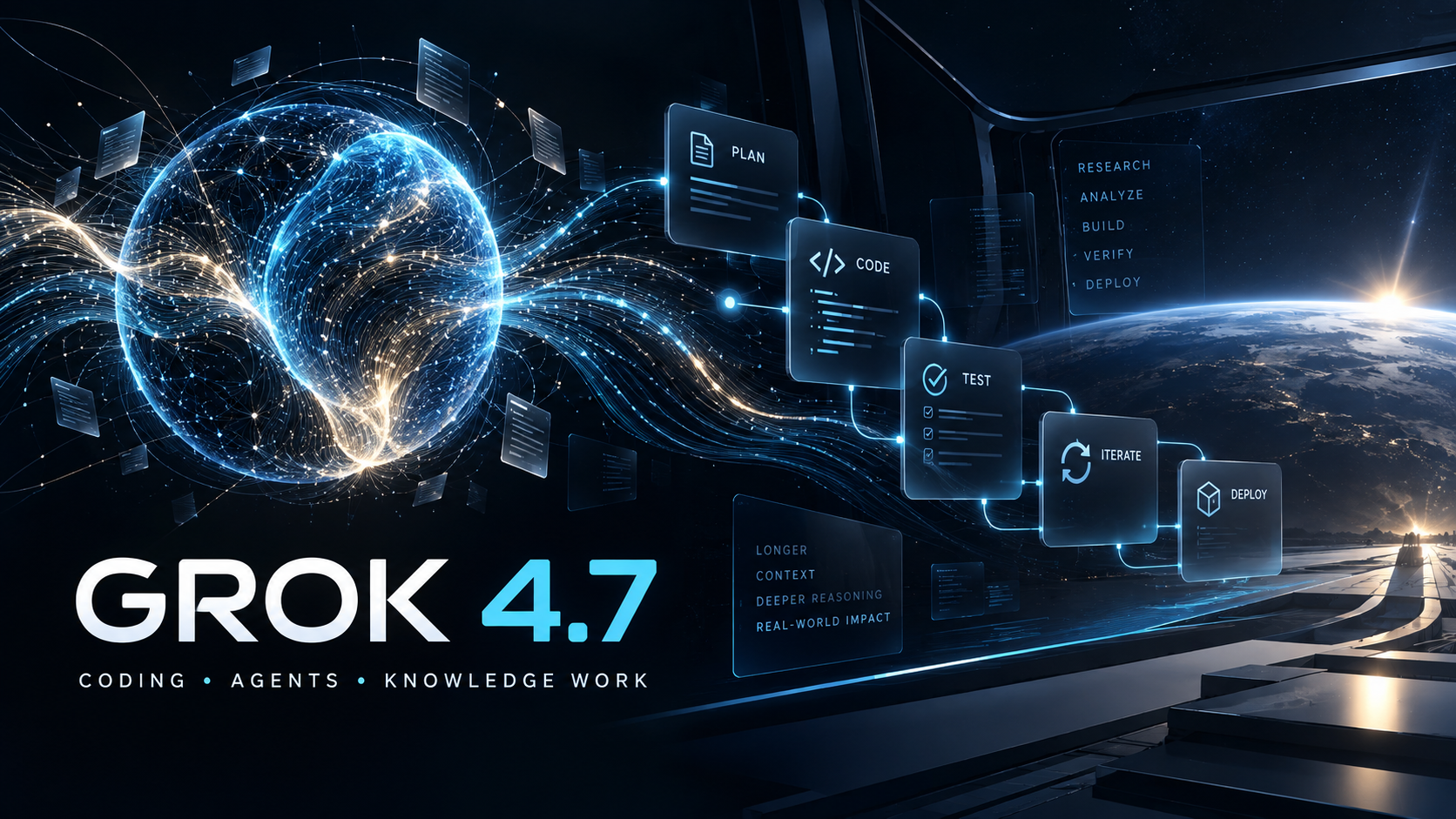
Summary
SpaceXAI released Grok 4.7 on September 21, positioning it as its most capable model yet for coding and knowledge work. The release uses a larger base model than Grok 4.6, adds longer reinforcement-learning training focused on multi-hour tasks, and keeps the same base API price.
The model is available through the Grok API, Cursor, Grok Build and other supported coding platforms. GitHub also began rolling Grok 4.7 into Copilot on launch day, giving the release immediate distribution across mainstream developer workflows.
Quick Take
- Grok 4.7 is SpaceXAI's new frontier model for coding, agents and knowledge work.
- API pricing starts at $2/M input and $6/M output tokens below the long-context pricing threshold.
- The model keeps a 500,000-token context window and supports text and image input.
- SpaceXAI reports sizable gains over Grok 4.6 on long-running coding and agent benchmarks.
- GitHub Copilot began rolling out Grok 4.7 on September 21.
What changed from Grok 4.6
SpaceXAI says Grok 4.7 uses a new, larger base model and a longer reinforcement-learning run on a harder task mix weighted toward work that can take hours. The company also trained the model to understand its Grok Bot harness natively and says it is better at checking its own work.
The pricing headline is unusually simple: the standard model remains at the same base rate as Grok 4.6. SpaceXAI's API release notes list $2 per million input tokens, $0.50 per million cached input tokens and $6 per million output tokens for prompts below 200,000 tokens. Requests above that threshold use a higher $4/$1/$12 rate.
That long-context tier matters when comparing real workload cost. A flat headline price does not mean every long agent run costs the same, especially when a model is explicitly designed to work for longer and may consume more reasoning or output tokens.
Original-value analysis: the upgrade is about task horizon, not context size
The most important change is not a larger context window. Grok 4.7 remains in the same 500,000-token context class as Grok 4.6.
Instead, SpaceXAI is targeting task horizon: how long a model can continue working, checking intermediate results and recovering from mistakes before it finishes a job.
| Dimension | Grok 4.6 | Grok 4.7 | Practical meaning |
|---|---|---|---|
| Base API price | $2 input / $6 output per M | $2 input / $6 output per M | No base-rate increase |
| Context window | 500K | 500K | Capacity is not the main upgrade |
| Training emphasis | Long-running agents | Harder multi-hour tasks | More focus on sustained work |
| CursorBench 4.0 | 40.4% | 46.3% | Company-reported coding gain |
| Terminal-Bench 4.0 | 20.3% | 38.0% | Large company-reported gain on terminal tasks |
These benchmark numbers come from SpaceXAI's own launch materials and should be treated as vendor-reported results, not independent proof that Grok 4.7 is the best model for every coding workload.
Where the value proposition gets interesting
SpaceXAI's benchmark table does not show Grok 4.7 winning every category. Claude Fable 5.1 remains ahead on several reported tests, while GPT-5.6 Sol is competitive or stronger on others.
That makes Grok 4.7's strongest argument price-performance rather than universal benchmark leadership. For teams running large volumes of coding or agent work, a model that approaches frontier performance while holding a lower token price can be economically important even when another model wins the absolute score.
The second important signal is distribution. GitHub says Grok 4.7 is rolling out to Copilot Pro, Pro+, Max, Business and Enterprise users across Visual Studio Code, Visual Studio, Copilot CLI, the Copilot cloud agent and other supported IDEs. That puts the model directly inside established software-development workflows rather than limiting it to SpaceXAI's own products.
Safety changes deserve separate scrutiny
SpaceXAI says Grok 4.7 ships with an entirely new safeguard stack and reports stronger jailbreak resistance and safer behavior in cybersecurity and biological-risk testing.
Those claims are relevant because the model is designed for longer autonomous work. Longer-horizon agents increase the importance of permission boundaries, monitoring and safe tool use.
But the safety figures are primarily vendor-reported. They should be evaluated separately from coding capability and revisited as independent evaluations become available.
Who should care
Grok 4.7 is most relevant to developers and teams already using Grok 4.6, Cursor, GitHub Copilot or agentic coding workflows. The same-price upgrade makes testing relatively straightforward for existing Grok API users.
Teams choosing between frontier models should not switch based on one benchmark table. The better test is workload-specific: compare task success, total tokens consumed, latency and intervention rate on the jobs that actually matter.
AI World Scope take
Grok 4.7 qualifies as a meaningful frontier-model release because it combines a new larger base model, stronger long-horizon training and immediate developer-platform distribution without raising its base API price.
The strategic signal is clear: the frontier competition is shifting from short benchmark answers toward agents that can remain useful across longer, messier jobs. For buyers, that makes cost per completed task more important than price per token or a single benchmark score.
What to watch next
The next useful evidence will come from independent evaluations of Grok 4.7's long-running coding performance, token consumption and safety behavior. Also watch whether SpaceXAI's same-price strategy pressures competing frontier providers on coding-agent pricing.
Sources & Documentation
Sources used for this article, with source type and publisher shown where available.
- officialIntroducing Grok 4.7Visit Source
- documentationRelease Notes — Grok 4.7Visit Source
- officialGrok 4.7 is now available in GitHub CopilotVisit Source