OpenAI Launches GPT-6 Sol and Luna With 50% Lower API Prices
OpenAI expands GPT-6 with Sol and Luna, cutting API prices 50% versus their GPT-5.6 predecessors while targeting coding, agents and high-volume work.
Summary
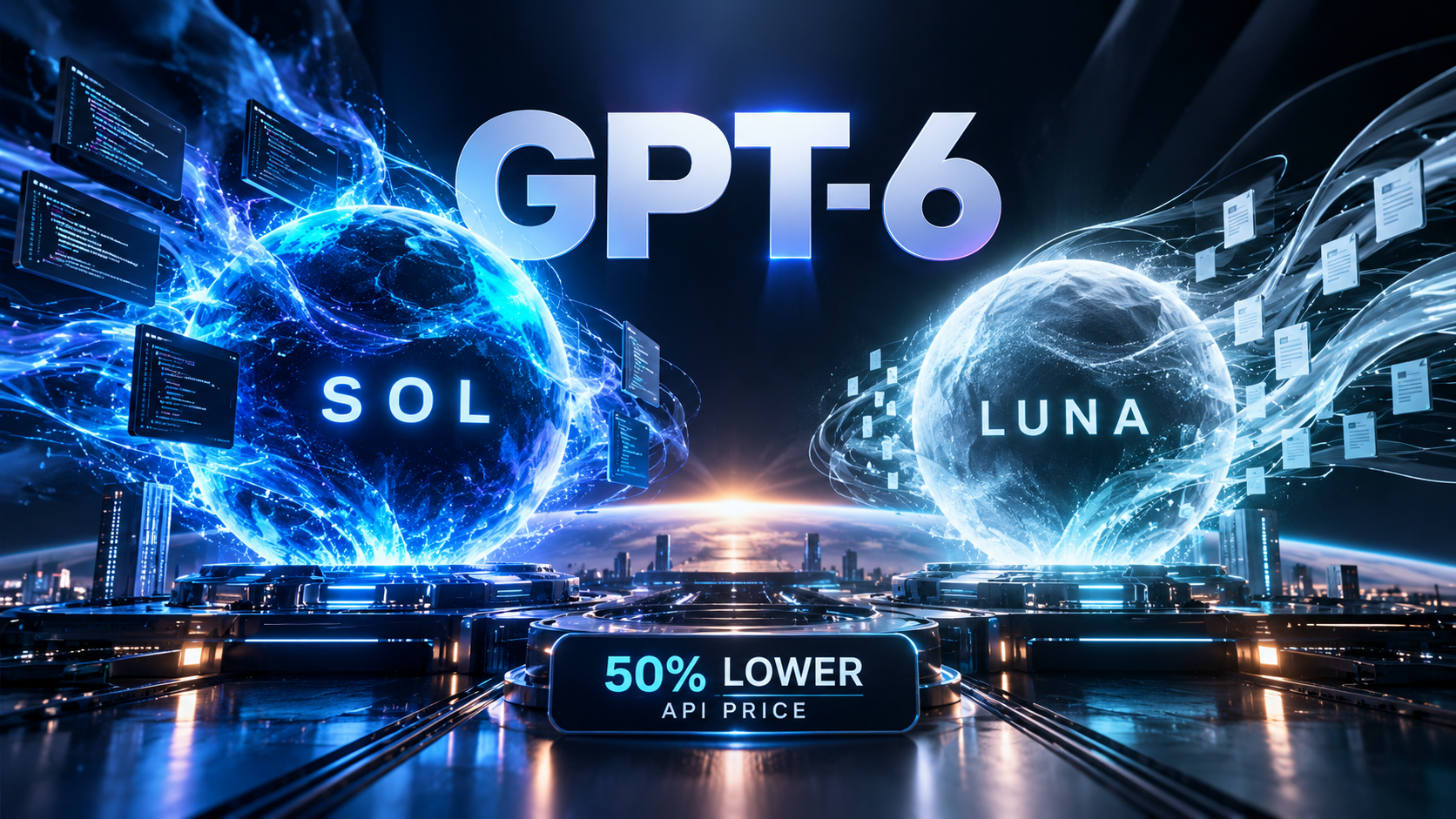
OpenAI has expanded the GPT-6 family with GPT-6 Sol and GPT-6 Luna, two lower-cost models aimed at everyday coding, agent and high-volume workloads. GPT-6 Sol costs $2 per million input tokens and $10 per million output tokens, while GPT-6 Luna costs $0.10 input and $0.50 output. OpenAI says both are 50% cheaper than the promotional API pricing of their GPT-5.6 predecessors.
Both models are available through the OpenAI API, ChatGPT Work and Codex. OpenAI says rollout into ChatGPT is gradual.
Quick Take
- GPT-6 Sol targets complex coding and agentic work at $2/M input and $10/M output.
- GPT-6 Luna targets high-volume work at $0.10/M input and $0.50/M output.
- Both have a 1.05M-token context window and 128K maximum output.
- OpenAI reports gains in coding, professional workflows, factuality and computer use.
- The launch turns GPT-6 into a three-tier family spanning Astra, Sol and Luna.
The biggest change is the price-performance curve
GPT-6 Astra remains OpenAI's flagship. Sol and Luna instead push GPT-6 capabilities down the cost curve.
| Model | Input / 1M | Output / 1M | Context | Best fit |
|---|---|---|---|---|
| GPT-6 Astra | $10 | $50 | 1.05M | Highest-capability work |
| GPT-6 Sol | $2 | $10 | 1.05M | Complex coding and agents |
| GPT-6 Luna | $0.10 | $0.50 | 1.05M | High-volume focused tasks |
That creates a 100x spread in input price between Astra and Luna while keeping the same headline context-window size. For developers, model selection is increasingly about how much intelligence a task needs rather than how much context a model can accept.
Sol becomes the middle of the GPT-6 stack
OpenAI describes GPT-6 Sol as built for complex coding and agentic workflows. Its API documentation lists a 1,050,000-token context window, 128,000 maximum output tokens, text and image input, reasoning support, and tools including web search, file search, code interpreter, computer use, hosted shell and MCP.
OpenAI reports Sol at maximum effort scoring 68.8% on DeepSWE 1.1, compared with 69.9% for Claude Fable 5 at xhigh effort, while costing roughly 80% less per task in OpenAI's comparison. On OSWorld 2.0 offline, OpenAI reports Sol at xhigh effort scoring 60.5%, close to Claude Opus 5 at medium effort at 60.3%.
These are vendor-reported comparisons, not a universal model ranking. Results depend on harnesses, reasoning settings and workload mix.
Luna may be the more disruptive release
At $0.10 per million input tokens and $0.50 per million output tokens, Luna is priced for workloads where token volume dominates economics: extraction, classification, summarization, background agents and repeated document processing.
OpenAI's documentation gives Luna the same 1.05M context and 128K maximum output as Sol. The company reports Luna at max effort scoring 66.6% on DeepSWE 1.1, which it says is comparable with Claude Opus 5 and Fable 5 at medium effort while costing far less per task.
The practical implication is bigger than a benchmark result: a sufficiently capable model at Luna's price can change which tasks are economically reasonable to automate.
Original-value analysis: token price is no longer enough
For agent workloads, the useful metric is increasingly cost per completed task, not simply cost per million tokens. A cheap model that needs repeated retries can cost more than an expensive model that succeeds immediately. A lower-cost model with adequate reliability, however, can make always-on or high-volume agents viable.
There is another cost lever: caching. OpenAI says GPT-6 can discount cached input-token reads by up to 90%, while GitHub reports that caching improvements reduced the share of prompt tokens requiring fresh processing by more than 50% across billions of requests to OpenAI models.
For persistent agents that repeatedly carry system instructions, tool definitions and prior context, caching can therefore matter almost as much as the headline token rate.
Who should use which model?
Astra remains the choice when maximum capability matters more than cost.
Sol is the practical tier for demanding coding, agentic and professional workloads where teams want strong capability without Astra pricing.
Luna is the interesting option for high-volume automation, document pipelines and background agents where marginal cost determines whether a workflow can scale.
Teams should still benchmark their own work. Completion rate, latency, tool use, reasoning effort, retries and total tokens consumed matter more than one vendor benchmark.
AI World Scope take
GPT-6 Sol and Luna matter because they complete OpenAI's GPT-6 product stack. Astra established the new capability ceiling; Sol and Luna attack a different constraint: the cost of deploying capable agents at scale.
The strategically important number may therefore be the 50% API price reduction versus GPT-5.6 Sol and Luna, combined with stronger reported capability. If those economics hold up in independent testing, GPT-6's broadest impact may come from how cheaply useful intelligence can be deployed repeatedly.
What to watch next
Watch independent evaluations of Sol and Luna, especially real cost per completed coding or agent task, and how Anthropic, Google and SpaceXAI respond on pricing after recent Claude Opus 5.5 and Grok 4.7 releases.
Sources & Documentation
Sources used for this article, with source type and publisher shown where available.
- officialIntroducing GPT-6 Sol and LunaVisit Source
- documentationGPT-6 Sol ModelVisit Source
- documentationGPT-6 Luna ModelVisit Source
- newsOpenAI launches GPT-6 Sol and Luna, boasting lower cost and fewer mistakesVisit Source