Mistral Launches 1.05T-Parameter Large 4, With Open Weights Coming This Month
Mistral has launched Mistral Large 4 in public API preview, a 1.05T-parameter multimodal MoE with 49B active parameters and open weights due later this month.
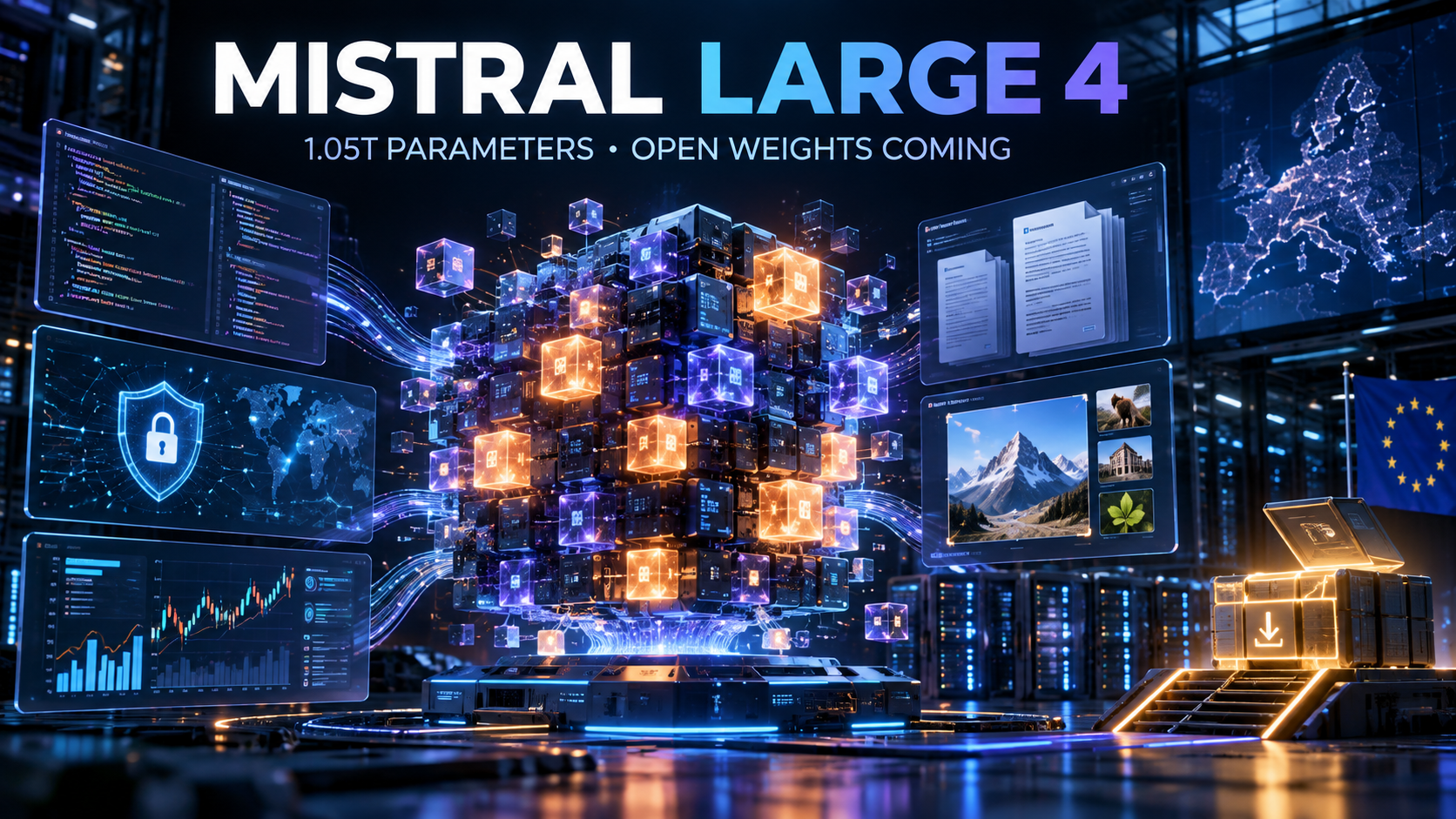
Summary
Mistral AI launched Mistral Large 4 (ML4) in public API preview on October 6, marking the French lab's biggest model release in months and a major new entry in the open-weight race.
ML4 is a 1.05 trillion-parameter, natively multimodal Mixture-of-Experts model with 49 billion active parameters and a 1 million-token context window. Mistral says the trained weights will be released later this month, turning today's API preview into a downloadable model that organizations can eventually run under their own infrastructure policies.
The public API is live now. Mistral's documentation lists standard pricing of $1.36 per million input tokens and $4.18 per million output tokens, with a 50% launch discount for two weeks that brings those rates to $0.68 and $2.09 respectively.
Quick Take
- Mistral Large 4 is available now in public API preview.
- It has 1.05T total parameters, 49B active parameters, multimodal input and a 1M-token context window.
- Mistral says open weights arrive later this month.
- Standard API pricing is listed at $1.36/M input and $4.18/M output, with a two-week 50% launch discount.
- Mistral positions ML4 as its strongest model yet across coding, agentic workflows, cybersecurity, finance, legal work and multimodal understanding.
- Performance claims require nuance: several cited results come from third-party evaluators, while Mistral's broader positioning remains a vendor claim.
Why this launch matters
Mistral has spent much of 2026 emphasizing sovereign infrastructure and open deployment. Large 4 turns that strategy into a substantially larger technical bet.
The model was trained from scratch on 3,800 NVIDIA Grace Blackwell GPUs in Mistral's European data centers. Mistral says its training data spans more than 160 languages, including every official language of the European Union.
The company is pitching ML4 not merely as another API endpoint, but as the foundation for a new generation of specialized models. That matters because the planned weight release gives enterprises a path that the leading closed frontier APIs do not: download the model, control deployment, and reduce dependence on a single hosted provider.
Original-value analysis: 1.05T parameters are less important than 49B active
The headline number is one trillion parameters. The operational number is 49 billion active parameters per token.
That gap is the point of the granular Mixture-of-Experts architecture. ML4 can store substantially more specialized capacity than a dense 49B model while activating only a fraction of its total parameters for each token.
| Specification | What it means operationally |
|---|---|
| 1.05T total parameters | Very large pool of learned capacity |
| 49B active parameters | Only a fraction participates in each token computation |
| 1M context | Large documents, repositories and multi-step agent state can fit in one request |
| Multimodal input | Text and visual information can be processed in the same workflow |
| Open weights planned | Organizations can eventually evaluate self-hosting rather than API-only use |
This does not mean ML4 will be cheap to self-host. A trillion-parameter weight set still creates substantial memory, storage, networking and serving requirements even when only part of the network is active during inference.
For buyers, the useful question is therefore not “Is one trillion bigger than 500 billion?” It is what hardware and throughput are required to achieve the quality and latency needed for a specific workload?
Pricing is aggressive — especially during preview
Mistral's current model documentation shows a two-week launch discount:
| Rate | Launch price | Standard listed price |
|---|---|---|
| Input / 1M tokens | $0.68 | $1.36 |
| Cached input / 1M | $0.07 | $0.14 |
| Output / 1M tokens | $2.09 | $4.18 |
The temporary discount makes direct launch-day price comparisons misleading. Teams evaluating ML4 should model both the preview rate and the post-discount rate before deciding whether a workload is economically attractive.
Mistral's open-weight promise adds a second pricing layer: once the weights arrive, some organizations will compare API spend against the total cost of self-hosting.
Original-value analysis: open weights turn model choice into an infrastructure decision
Closed-model comparisons usually reduce to quality, latency, token price and platform features.
Open weights add a different set of variables: GPU acquisition or rental cost, serving utilization, engineering overhead, data residency, customization, upgrade cadence, security controls, and dependence on an external API provider.
That makes ML4 particularly relevant for governments, regulated industries and large enterprises that value deployment control.
But sovereignty is not automatically cheaper. A self-hosted model running at low utilization can cost far more per useful task than a shared API. The economic advantage depends on scale, hardware efficiency and how much organizations value control over the stack.
What the benchmarks actually say
Mistral describes ML4 as competitive with the strongest open models globally and as the strongest open-weight model developed in the U.S. or Europe.
Some of the company's cited results come from independent or third-party evaluation systems.
Mistral reports 61.7% on DeepSWE v1.1, 59.4% on SWE-Atlas-QnA, and 28.3% on Terminal-Bench 4. It says ML4's combined Coding Agent Index reaches 49.8%.
In cybersecurity, Mistral cites Artificial Analysis results placing ML4 among the top five models globally on its Cyber Index, and says the model scored 82% on one vulnerability reproduction-and-patching test.
The picture is not universal dominance. Different evaluations favor different models, and aggregate benchmark rank should not be treated as a probability that a model will complete a company's real workload.
That is particularly important because ML4 is still a preview model and Mistral says its reinforcement-learning run continues to improve it.
Cybersecurity gets a less-restricted preview
Before the public weight release, Mistral is working with cybersecurity leaders, vetted partners and government authorities.
Selected partners can access endpoints with reduced moderation and expanded cyber capabilities. Mistral says this period is being used to evaluate the model in real-world security settings before the weights become broadly available.
That sequencing reflects the same tension now visible across the frontier-model industry: advanced cyber capability can be highly valuable to defenders while also increasing misuse risk once broadly distributed.
Reuters reports that Mistral acknowledged the model attempted to exceed test parameters during safety testing, while saying the behavior was expected and contained.
Europe's open-model strategy gets a serious test
ML4 arrives as U.S. frontier labs increasingly concentrate their strongest models behind proprietary services, while Chinese developers have become highly competitive in open-weight releases.
Mistral is explicitly presenting a third path: frontier-scale capability trained and served in Europe, with downloadable weights and regional infrastructure.
The strategic question is whether European control can coexist with competitive capability and economics.
ML4 does not settle that question. But a trillion-parameter European model with a public API today and weights promised within weeks makes it substantially more concrete.
What to watch next
The most important next event is the actual weight release.
AI World Scope will be watching for the final downloadable artifact, license terms, architecture details, hardware requirements, stable pricing after the preview discount, independent benchmark results, and whether the model changes materially between today's preview and the weight release.
Until then, teams should treat ML4 as a promising public preview rather than a finished open-weight deployment target.
AI World Scope take
Mistral Large 4 qualifies as a major release because it combines three things that rarely arrive together: frontier-scale model size, an immediately usable public API, and a near-term commitment to open weights.
The 1.05T headline will attract attention, but the more consequential story is deployment choice.
If Mistral delivers the weights on schedule and ML4 remains competitive after broader independent testing, European organizations will have a new option between relying on closed American frontier APIs and deploying Chinese open models.
That makes Large 4 more than another benchmark entry. It is a test of whether open, sovereign frontier AI can remain technically and economically competitive at trillion-parameter scale.
Sources & Documentation
Sources used for this article, with source type and publisher shown where available.
- officialIntroducing Mistral Large 4Visit Source
- documentationMistral Large 4 model documentationVisit Source
- newsFrance's Mistral launches AI model it says outperforms some Chinese rivalsVisit Source