AI Customer Support Cost: 1,000 to 100,000 Conversations
A reproducible token budget for three support APIs, with conversation-volume scenarios, sensitivity checks and human-escalation break-even math.
Summary
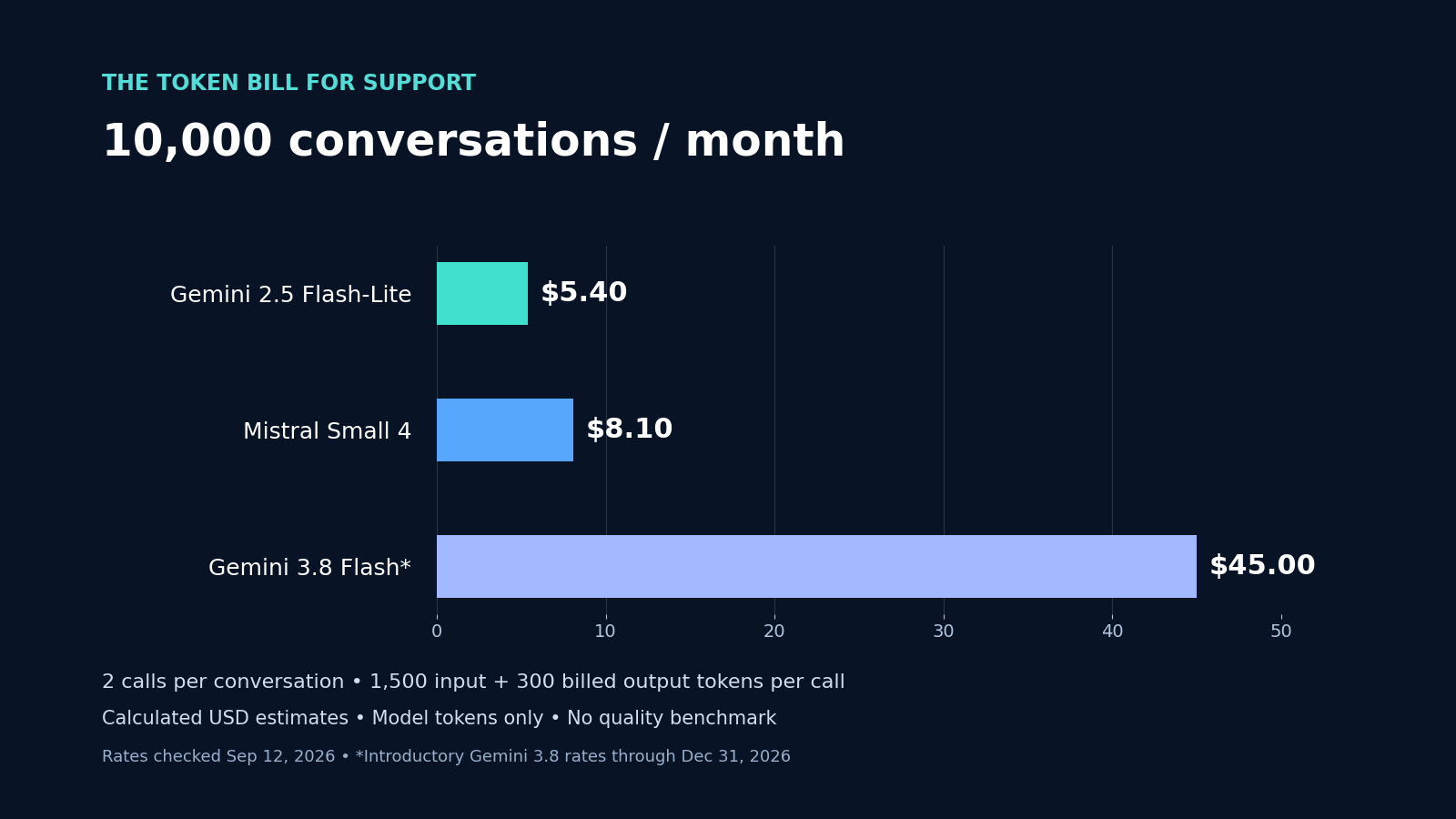
For a text-based support workflow with two model calls per conversation, 1,500 input tokens and 300 billed output tokens per call, 10,000 conversations cost an estimated $5.40 to $45 in model tokens across the three APIs below. That is the inference budget, not the price of operating a complete support service.
This guide turns a conversation forecast into a reproducible budget, shows what changes when conversations get longer, and separates token spending from human escalation. Prices were checked on September 12, 2026. All workload volumes are illustrative assumptions; AI World Scope has not measured these models' support accuracy or resolution rates.
Quick Take
- 10,000 conversations: estimated model-token costs range from $5.40 to $45 under our stated assumptions.
- Count every call: one conversation can trigger several separately billed requests.
- Budget beyond tokens: integration, retrieval, monitoring and human escalation need separate cost lines.
- Test quality separately: a cheaper response is not necessarily a correctly resolved case.
Define a conversation before pricing it
Here, a conversation means one customer case entering the workflow. It is not a claim that the case is resolved, that a single message is sufficient, or that every conversation has the same length.
The baseline assumes two calls per conversation. Each call receives an average of 1,500 input tokens and produces 300 billed output tokens. Input includes whatever instructions, policy excerpts, customer text and history you actually send. Output means billed output, including billed thinking where applicable, rather than only the words displayed to the customer.
These are planning inputs, not measured industry averages. Replace them with usage records from a representative sample before committing to a budget. A multilingual help desk, a lengthy refund dispute and a simple delivery question should not automatically share the same assumptions.
| Planning input | Baseline assumption |
|---|---|
| Conversations per month | 1,000 / 10,000 / 100,000 |
| Average model calls per conversation | 2 |
| Average input tokens per call | 1,500 |
| Average billed output tokens per call | 300 |
| Pricing basis | Standard paid API rates, USD |
| Excluded from the estimate | Caching discounts, tools, infrastructure, labor and taxes |
The calculation you can reproduce
Monthly input tokens equal conversations multiplied by calls per conversation multiplied by input tokens per call. Repeat that calculation for output. Multiply each total, in millions, by its corresponding rate, then add the two costs.
At 10,000 conversations, the example produces 20,000 calls, 30 million input tokens and 6 million output tokens. That means a model priced at $0.10 input and $0.40 output per million tokens costs $3 for input plus $2.40 for output: $5.40 altogether.
Keep those two components separate in your spreadsheet. A change in context length affects input, while a change in answer length or billed reasoning can affect output. One blended token rate hides the reason a forecast moved.
Three APIs under the same workload
Google lists Gemini 2.5 Flash-Lite at $0.10 input and $0.40 output per million tokens. Gemini 3.8 Flash has introductory standard rates of $0.75 and $3.75 through December 31, 2026; its listed January 2027 rates are $1.50 and $7.50. See Google's pricing documentation.
Mistral lists Small 4 at $0.15 input and $0.60 output per million tokens on its official model page.
| Model | Input / output per 1M tokens | 1,000 conversations | 10,000 conversations | 100,000 conversations |
|---|---|---|---|---|
| Gemini 2.5 Flash-Lite | $0.10 / $0.40 | $0.54 | $5.40 | $54.00 |
| Mistral Small 4 | $0.15 / $0.60 | $0.81 | $8.10 | $81.00 |
| Gemini 3.8 Flash, introductory rates | $0.75 / $3.75 | $4.50 | $45.00 | $450.00 |
These are calculated spending scenarios, not a quality ranking or an exhaustive list of support models. Equal token allowances do not establish equivalent responses. Identical text may also tokenize differently across providers; a production comparison should use each provider's actual usage records.
Open the matching calculator setup for 1,000 conversations, 10,000 conversations, or 100,000 conversations. The links restore assumptions and recalculate using the current catalog, so future totals can differ from this dated table.
For capabilities and source notes, see Flash-Lite, Small 4 and Gemini 3.8 Flash. Our broader API price guide covers other workload types.
Stress-test the assumptions
Two changes are especially easy to miss: more calls and more text per call. Keeping everything else fixed, increasing calls from two to six triples this estimate. Doubling input alone does not double the whole bill, because output remains unchanged.
| Scenario at 10,000 conversations | Flash-Lite | Small 4 | Gemini 3.8 Flash |
|---|---|---|---|
| Baseline: 2 calls, 1,500 input, 300 output | $5.40 | $8.10 | $45.00 |
| 6 calls, same average sizes | $16.20 | $24.30 | $135.00 |
| 2 calls, 3,000 input, 300 output | $8.40 | $12.60 | $67.50 |
A six-turn conversation with growing history may cost more than the fixed-size six-call example. Count retries, classification calls and summarization calls too. If a router uses another model, give it its own budget line rather than pretending every request uses the same rate.
For a budget extending into 2027, the currently listed post-introductory Gemini 3.8 Flash rates would make its baseline $90 per 10,000 conversations. Recheck all rate cards before renewal; today's verified price is not a permanent quote.
Build the complete support budget
Create separate lines for model tokens, retrieval or search, hosting, monitoring, maintenance and human handling. A help-desk subscription or per-resolution product fee belongs in the budget if your architecture actually uses it. Avoid counting the same bundled service twice.
As a purely hypothetical planning example, 10,000 conversations with a 10% escalation rate produce 1,000 human-handled cases. At five minutes each, that is about 83.3 hours. At an assumed fully loaded $20 per hour, handling costs roughly $1,667. Those numbers are invented assumptions, not salary research or measured performance from any model.
This illustrates why escalation deserves measurement. Under those labor assumptions, one percentage point fewer escalations saves about $166.67 per 10,000 conversations. The token-price difference between Flash-Lite and Gemini 3.8 Flash in our baseline is $39.60. A hypothetical reduction of about 0.24 percentage points would offset that difference, if all other costs and risks were equal. We have no evidence that either model achieves that reduction.
Choose with an acceptance test
Before changing the model, define what an acceptable answer must do: apply the supplied policy, avoid unsupported promises, preserve relevant facts and escalate when the policy is insufficient. Include straightforward requests, ambiguous questions, multilingual cases and attempts to override instructions.
Run candidates on the same representative cases and retain failed attempts. Record total billed cost, correct answers, necessary escalations, latency and human review time. Do not count an unsafe refusal to escalate as a productivity gain.
For assisted support, cost per accepted draft may be useful. For autonomous support, evaluate correctly resolved cases and subsequent reopens. Those are different outcomes; choose the denominator that matches the service you intend to deliver.
AI World Scope take
Use this calculator to narrow the budget discussion, then validate the workflow with actual cases. The decision should combine acceptable quality, operating constraints and total cost. A low token bill is useful, but it cannot prove that a support system handles customers well.
Start with a small pilot, record the real call and token distributions, and replace every illustrative assumption above. Keep a base forecast and a heavier-use scenario. That gives you a budget you can explain and update when the workflow or provider pricing changes.
Sources & Documentation
Sources used for this article, with source type and publisher shown where available.
- documentationGemini Developer API pricingVisit Source
- documentationMistral Small 4 model documentationVisit Source