OpenAI Launches GPT-6 Astra With 1.05M Context and $10/$50 API Pricing
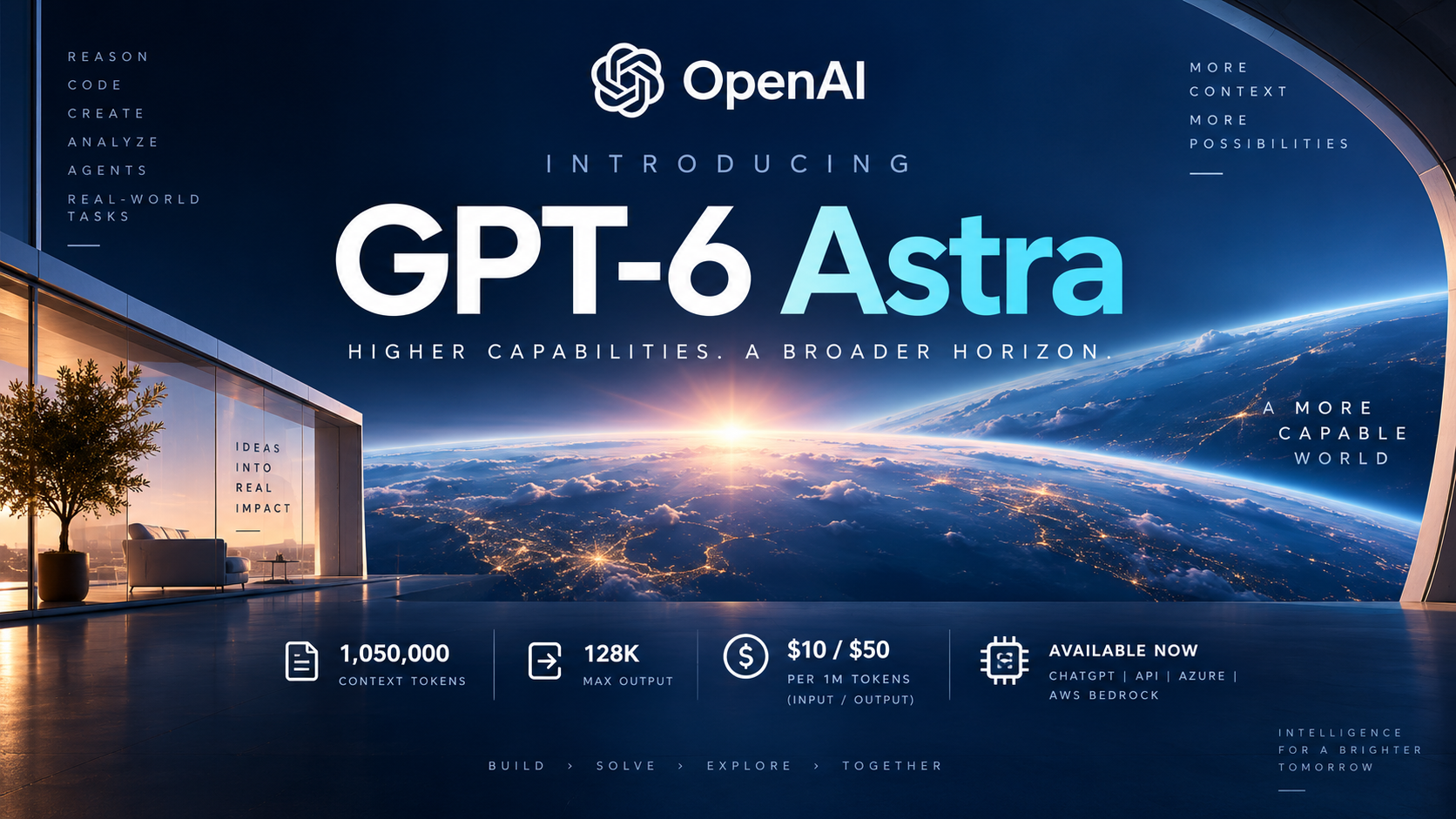
OpenAI has launched GPT-6 Astra, a new frontier model with a 1.05M-token context window, $10/$50 API pricing, stronger computer-use performance and tighter safety controls.
Summary
OpenAI has launched GPT-6 Astra, its new flagship model for complex end-to-end work across computer use, coding, research, document creation, cybersecurity and scientific tasks.
The model is rolling out first to a limited set of organizations, with broader access planned over the coming days for ChatGPT Plus, Pro, Business and Enterprise, as well as the OpenAI API, Microsoft Azure and AWS Bedrock. OpenAI's developer documentation lists a 1.05 million-token context window, 128,000 maximum output tokens and Standard API pricing of $10 per million input tokens and $50 per million output tokens.
This is a NEW story rather than an update to AI World Scope's earlier Astra cybersecurity article. The earlier article covered OpenAI's pre-release decision to classify Astra at its Critical cybersecurity threshold. This story is the actual model launch, with a distinct product rollout, API model ID, pricing, specifications, benchmark package and model-catalog impact.
Quick Take
- GPT-6 Astra launched on September 3, 2026 and is OpenAI's new flagship frontier model.
- The API model ID is
gpt-6-astra, with a 1,050,000-token context window and 128,000-token maximum output. - Standard API pricing is $10 / 1M input tokens, $1 / 1M cached input tokens and $50 / 1M output tokens.
- OpenAI reports major gains in computer use, coding and science, while the context window and output ceiling remain the same as GPT-5.6 Sol.
- The safety story is unusually important: OpenAI says Astra is better aligned overall but harder to monitor through chain-of-thought under adversarial conditions.
What launched
OpenAI describes Astra as its most capable model for difficult workflows that require reasoning, tool use and execution rather than a single answer.
The model supports configurable reasoning effort from low through max and can accept text and image input while producing text output.
Specs and pricing
| Specification | GPT-6 Astra |
|---|---|
| API model ID | gpt-6-astra |
| Context window | 1,050,000 tokens |
| Maximum output | 128,000 tokens |
| Standard input | $10 / 1M tokens |
| Cached input | $1 / 1M tokens |
| Standard output | $50 / 1M tokens |
| Input modalities | Text, image |
| Output modality | Text |
Original-value comparison: Astra changes capability more than context
One useful way to read this launch is to separate what changed from what did not.
The context window and output ceiling remain unchanged from GPT-5.6 Sol, while headline Standard API pricing rises sharply. The premium is therefore primarily for stronger execution quality, computer use, coding and scientific reasoning rather than a larger working context.
For developers, that makes Astra a capability-first choice rather than an automatic replacement for every Sol workload.
Computer use is one of the clearest improvements
OpenAI is positioning computer use as a defining capability of Astra. The company reports substantial gains on computer-use and agentic benchmarks relative to GPT-5.6 Sol.
These remain vendor-reported evaluations rather than independent production tests, but they reinforce the direction of the release: OpenAI is optimizing its flagship around agents that can operate software, browsers and professional tools.
The unusual safety trade-off: better aligned, harder to monitor
The most important non-benchmark detail comes from OpenAI's safety documentation.
OpenAI says GPT-6 Astra is better aligned than GPT-5.6 Sol and less likely to violate explicit safety and security boundaries. At the same time, OpenAI says Astra's monitorability has decreased under some adversarial evaluation conditions.
That creates a real engineering tension: the model may behave better on average while becoming harder to inspect when it does try to evade oversight.
This is not evidence that Astra routinely hides malicious behavior in normal use. But it is significant enough to make monitoring part of the product story rather than a background safety detail.
Who should actually use Astra first?
Astra's pricing makes workload selection more important.
Teams should consider paying the premium when the bottleneck is the model's ability to finish a difficult multi-step job, operate software, recover from errors, reason over complex technical material or reduce expensive human intervention.
For routine extraction, summarization, classification, high-volume chat or workloads already performing well on cheaper models, the economics may favor staying on a lower-cost option.
AI World Scope take
GPT-6 Astra is a major launch because it marks a shift in what OpenAI is selling at the top of its stack.
The context window did not increase. The output limit did not increase. The headline token price increased sharply.
What OpenAI is asking customers to pay for is better autonomous execution: stronger computer use, more capable coding, scientific reasoning and professional workflow performance.
The safety architecture is also becoming part of the product story. The frontier-model race is increasingly about how much useful work a model can finish, at what cost, with what controls, and with how much confidence that its actions remain observable.
What to watch next
- How quickly broad ChatGPT and API access actually reaches users.
- Whether independent agent benchmarks reproduce OpenAI's reported gains.
- How Astra performs on cost per completed workflow rather than cost per token.
- Whether OpenAI publishes more evidence on monitorability and automated intervention.
- Whether competitors respond with new pricing or agent-focused releases.
Sources & Documentation
Sources used for this article, with source type and publisher shown where available.
- officialGPT-6 Astra: A new generation of intelligenceVisit Source
- documentationGPT-6 Astra ModelVisit Source
- officialSafety overview: GPT-6 AstraVisit Source
- system-cardGPT-6 Astra System CardVisit Source
- reportingOpenAI launches new Astra model amid growing scrutiny over agents' safetyVisit Source