Yandex Confirms Third Data Center Shutdown After Drone Attacks Hit AI Infrastructure
Yandex confirms a third data-center shutdown after drone attacks, disrupting cloud services and exposing AI-compute infrastructure to physical risk.
Summary
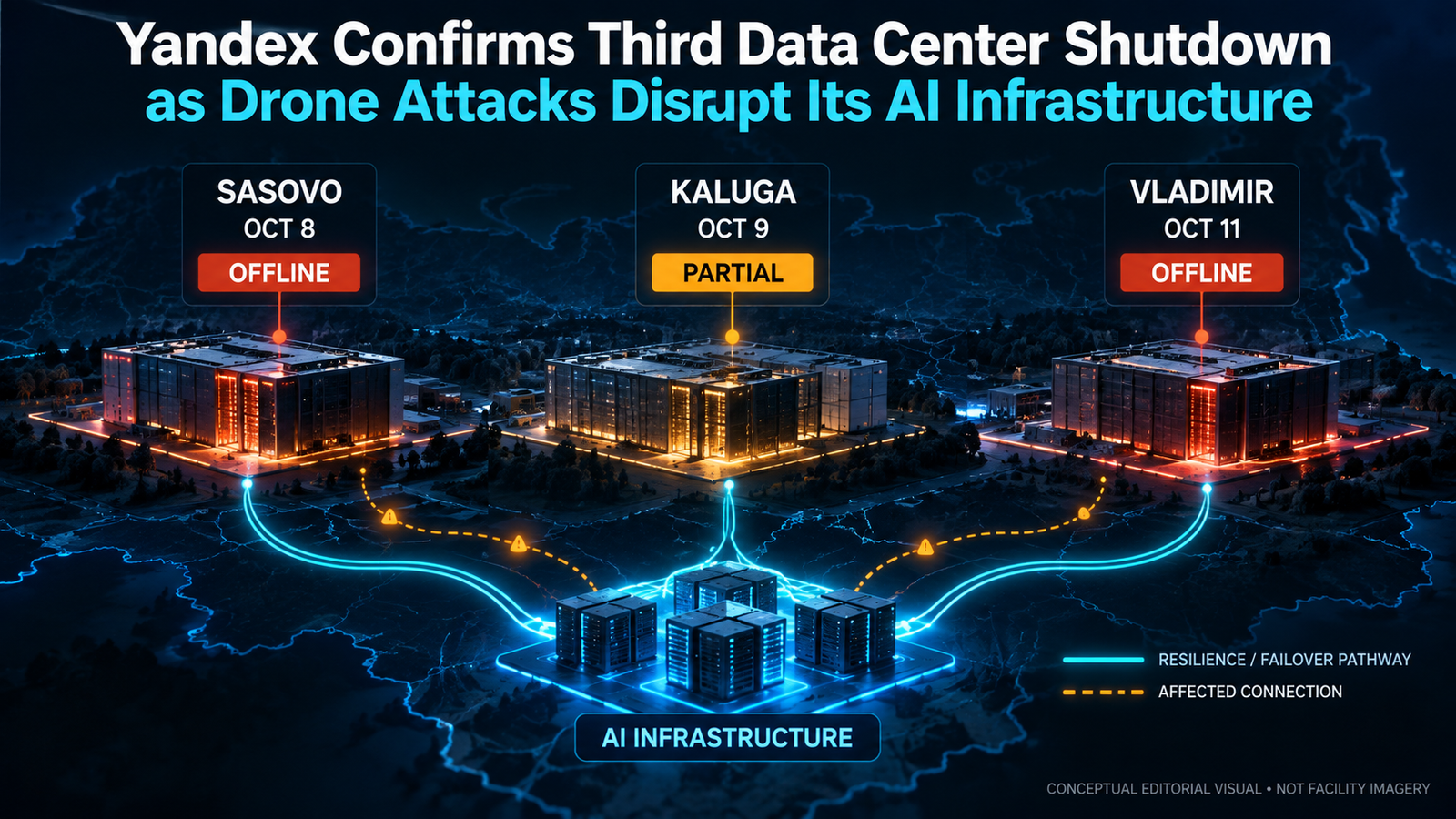
Russian technology company Yandex confirmed on October 11, 2026, that a drone attack had forced the complete shutdown of its data center in Vladimir. It was the third Yandex data-center site disrupted in four days: Sasovo was shut down after an October 7–8 strike, and Kaluga suffered a partial outage on October 9. Yandex said no employees were injured at the affected sites.
The facilities support cloud customers and Yandex's AI development. Reuters reported that two of its three AI-development supercomputers were housed at Sasovo; Kommersant places a third, Galushkin, at Vladimir. These locations do not prove the machines were destroyed or that all AI operations stopped.
Quick Take
- October 11: Yandex confirmed Vladimir's data center was fully shut down following a drone attack.
- Three sites affected: Sasovo is offline, Kaluga partly impaired, and Vladimir offline.
- AI compute exposure: Two AI-development supercomputers were housed at Sasovo, Reuters reports.
- Cloud disruption: Yandex warned customers about unstable resources and recommended disaster-recovery alternatives.
- Unknowns remain: Hardware damage, recovery timing, and the full effect on model development are not established.
Three facilities, three different operational states
| Facility | Reported incident | Confirmed operating condition | Why it matters |
|---|---|---|---|
| Sasovo, Ryazan region | Overnight October 7–8 | Completely shut down | Reuters says the site housed two AI-development supercomputers. |
| Kaluga | October 9 | Part of infrastructure out of service | Additional data-center capacity was affected, but not a confirmed full shutdown. |
| Vladimir | October 11 | Completely shut down | Yandex confirmed a third outage; Kommersant reports the Galushkin supercomputer was located there. |
An offline data center does not prove its servers or supercomputers are destroyed. Yandex has not given a reliable restoration timetable.
What the cloud outage actually means
Yandex's updated statement confirmed the three incidents. Reuters independently reported the sequence. Kommersant described customer disruptions and Yandex Cloud warnings about remaining capacity.
Kommersant reported that Yandex Cloud urged disaster-recovery plans and arranged accelerated customer relocation with other providers. Some services were recovering by October 11; that does not mean damaged facilities were restored.
Key distinction: Service availability, data integrity, and AI training capacity are different measures. Apps may recover through failover while training hardware remains unavailable. An offline facility does not prove permanent data loss.
Original analysis: the hidden dependency is physical concentration
The hidden dependency is physical concentration of compute. Large training clusters may be harder to relocate than web services because of accelerators, interconnects, storage locality, and power requirements.
A useful way to assess impact is to separate three questions:
| Layer | Evidence available now | Evidence still needed |
|---|---|---|
| Customer-facing services | Reported outages and partial recovery | Full restoration and customer impact totals |
| Cloud platform | Yandex's emergency warnings and migration advice | Verified zone-by-zone availability and data-recovery results |
| AI training infrastructure | Reported supercomputer locations at affected sites | Hardware condition, usable replacement capacity, and model-training delays |
This is an operational risk analysis, not a claim that Yandex has lost its models or permanently lost all three supercomputers.
Practical implications for AI infrastructure operators
Operators should map shared physical dependencies across availability zones, test off-provider backups, document recovery objectives, and assess whether training jobs can restart from checkpoints.
Inference endpoints and training clusters need different recovery plans. Kommersant quoted industry concerns about costly, slow hardware replacement; these are forecasts, not confirmed Yandex costs.
What to watch next
Watch for Yandex's next facility-status update, supercomputer condition, verified cloud recovery, and any measurable AI-development delays. Attack attribution is distinct from confirmed infrastructure status.
AI World Scope Take
Classification: NEW. The October 11 shutdown expands the incident to three sites. This is breaking news because a major AI and cloud provider faces cascading physical outages. The story is AI compute resilience, not an unverified claim of destroyed models or supercomputers.
Sources & Documentation
Sources used for this article, with source type and publisher shown where available.
- officialWhat is happening to our data centers, the iron heart of YandexVisit Source
- officialYandex official incident update confirming Vladimir shutdown (updated October 11)Visit Source
- officialYandex Cloud incident statementVisit Source
- newsRussia’s Yandex says data centre in Vladimir area shut down after drone attackVisit Source
- newsDrone attacks disrupt Yandex data centers and cloud servicesVisit Source