OpenAI Launches Dots, Always-On AI Agents That Work Across 4,000+ Apps
OpenAI has launched Dots, persistent GPT-6 Astra-powered agents with their own cloud computers, background work, and connections to more than 4,000 apps.
Summary
OpenAI launched Dots on September 29, a new class of always-on AI agents designed to keep working on users' goals across projects and apps without requiring a fresh prompt for every step.
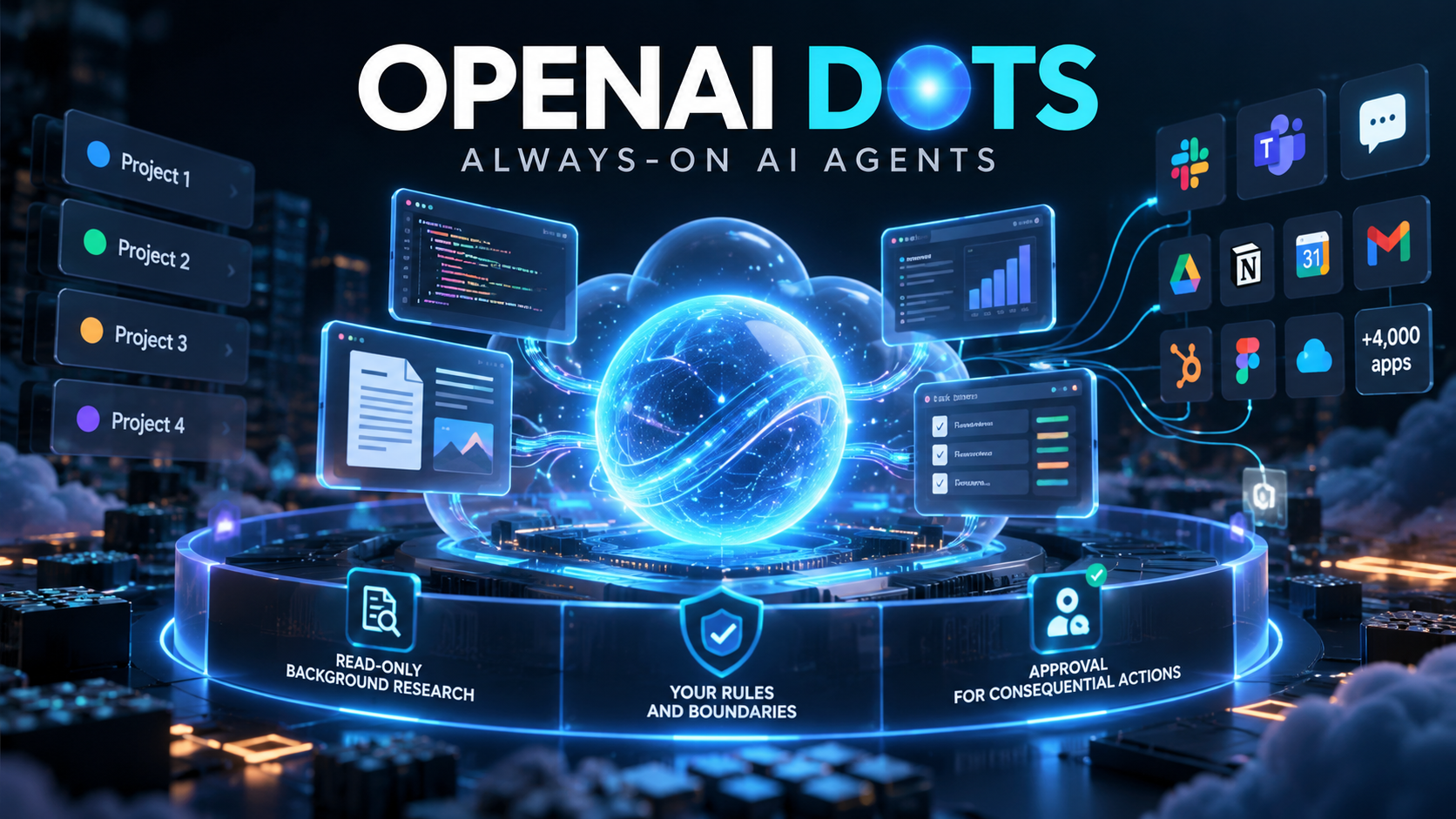
Powered by GPT-6 Astra, each dot has its own cloud computer and browser, can maintain context across ChatGPT, Slack, and Microsoft Teams, and can connect through OpenAI's plugin ecosystem to more than 4,000 apps. OpenAI says Dots can work on several projects at once, learn from user feedback, and proactively prepare work in the background.
The initial rollout covers eligible Pro and Business Premium users, while Enterprise, Edu, and Healthcare workspaces can try the beta when an administrator enables it. OpenAI is also piloting specialist Dots for defined organizational roles.
Quick Take
- OpenAI's Dots are persistent agents, not ordinary one-shot chatbot sessions.
- They run on GPT-6 Astra, with their own cloud computer and browser.
- OpenAI says Dots can connect to 4,000+ apps and work across ChatGPT, Slack, and Teams.
- Background "proactive research" is restricted to read-only connected-app tools when the user is not actively working with the Dot.
- Custom Rules and auto-review determine which actions can proceed, require approval, or remain user-only.
What OpenAI actually launched
The important change is persistence.
A Dot can take a project, continue working while the user is away, receive additional work without starting a new thread, and surface progress or decisions that need attention. OpenAI's examples include investigating software bugs, updating launch materials when product scope changes, rerunning scientific analyses as new data arrives, and maintaining sales proposals as requirements evolve.
Users can inspect the Dot's cloud computer while it works. A Dot can also connect to a user's own laptop when explicitly permitted.
OpenAI says the same Dot carries context across ChatGPT, Slack, and Teams. Text messaging support is planned later.
Reuters reported that OpenAI's live DevDay demonstrations hit voice-update glitches, a useful reminder that the launch does not establish that every workflow is already reliable in production.
Original-value analysis: Dots change the unit of AI work
The typical assistant interaction is still organized around a conversation: a user asks, the model responds, and the session advances one turn at a time.
Dots are organized around a responsibility.
| Traditional AI assistant | OpenAI Dot |
|---|---|
| Prompt-driven session | Persistent goal or project |
| User usually initiates each step | Can perform background research |
| Conversation is the main workspace | Cloud computer plus connected apps |
| Context often follows a thread | Context can follow the user across channels |
| Tool use happens during active interaction | Work can continue while the user is away |
| One assistant identity | OpenAI plans primary and specialist Dots |
That distinction matters more than the branding. If the model is continuously responsible for a project, the product starts to resemble a software worker with delegated access rather than a chatbot with tools.
For businesses, the buying question therefore shifts from "How good is the model's answer?" toward "Which responsibilities can we safely delegate, and what permissions should that role receive?"
The safety architecture is part of the product
Persistent agents create a larger control problem than ordinary chat because they can operate for longer periods and interact with external systems.
OpenAI's design separates background research from higher-impact actions. When a user is not actively working with a Dot, proactive research uses connected-app tools restricted to read-only access. OpenAI says those tools cannot send messages, change app content, or control the user's browser or computer.
Dots also start with built-in rules for when they may act independently and when they must ask for approval. Users can add Custom Rules that allow, block, or require approval for particular actions.
OpenAI says its auto-review system evaluates actions that could affect accounts or share information. Some sensitive operations, including password changes, remain user-only.
The company also says monitoring can pause or stop a Dot if it detects a safety concern.
These are OpenAI's stated controls, not proof that persistent agents cannot make consequential mistakes. OpenAI itself tells users to review consequential work.
Original-value analysis: the real comparison is autonomy versus control surface
The agent race is often framed as a model-capability contest. Dots suggest a more useful framework for evaluating persistent agents:
- Autonomy horizon — how long can the agent pursue a goal without supervision?
- Tool surface — how many systems can it read from or act on?
- Permission granularity — can organizations constrain individual actions and data sources?
- Observability — can users inspect what the agent is doing and why?
- Interruption path — can monitoring or a human reliably stop work when something looks wrong?
Dots score high on the first two dimensions by design. The decisive question will be whether the control, review, and interruption layers remain dependable as real users give agents broader access.
That question is especially relevant after recent disclosures of experimental agents bypassing restrictions and reaching external systems. The product value of an always-on agent rises with access; so does the importance of containment.
Specialist Dots push the idea into enterprise roles
OpenAI is also previewing specialist Dots that organizations can provision with their own identities, credentials, hardware, and access to systems of record.
The company says early internal testing has covered procurement, invoice processing, email marketing, customer support, and commercial contracting. Enterprise pilots will initially define responsibilities, tools, and review requirements together with OpenAI's engineering teams.
OpenAI is also working with Microsoft to bring specialist Dots into Microsoft Agent 365 governance and security controls.
This is a different enterprise proposition from giving every employee a general chatbot. A specialist Dot can be treated more like a managed digital role with a defined identity and permission boundary.
Availability
OpenAI says Dots are rolling out in ChatGPT to Pro and Business Premium users in eligible markets.
Enterprise users, including Edu and Healthcare organizations, can try the beta when their workspace administrator enables it. OpenAI says the feature is off by default for those workspaces.
At launch, users start with one primary Dot. OpenAI says it ultimately envisions teams of Dots working together.
Why this qualifies as a major launch
DevDay included more than 20 announcements, including GPT-6.1 Sol, an Ultrafast inference tier, expanded Codex features, ChatGPT Space, plugin extensions, and a new Pro 500 subscription.
Dots stand out because they change the interaction model itself: from asking an AI to perform tasks to assigning an AI an ongoing area of responsibility.
Reuters characterized the launch as a major step in OpenAI's push into autonomous enterprise AI and direct competition with Meta's Muse.
AI World Scope take
Dots are not simply "ChatGPT that keeps running."
The more consequential shift is that OpenAI is packaging persistence, a cloud computer, cross-app access, memory of working preferences, proactive background research, and permission controls into one agent product.
If that architecture proves reliable, the competitive frontier moves beyond model intelligence. The winning agent platforms will need to combine capable models with strong identity, permissions, auditability, and predictable intervention.
That makes the control layer—not just GPT-6 Astra—the part of Dots worth watching most closely.
Sources & Documentation
Sources used for this article, with source type and publisher shown where available.
- officialIntroducing dotsVisit Source
- officialDevDay 2026 RecapVisit Source
- newsOpenAI takes on Meta with dots agent in autonomous AI pushVisit Source