NVIDIA Agrees to Acquire Hugging Face for $12.93 Billion, Promises Platform Will Stay Open
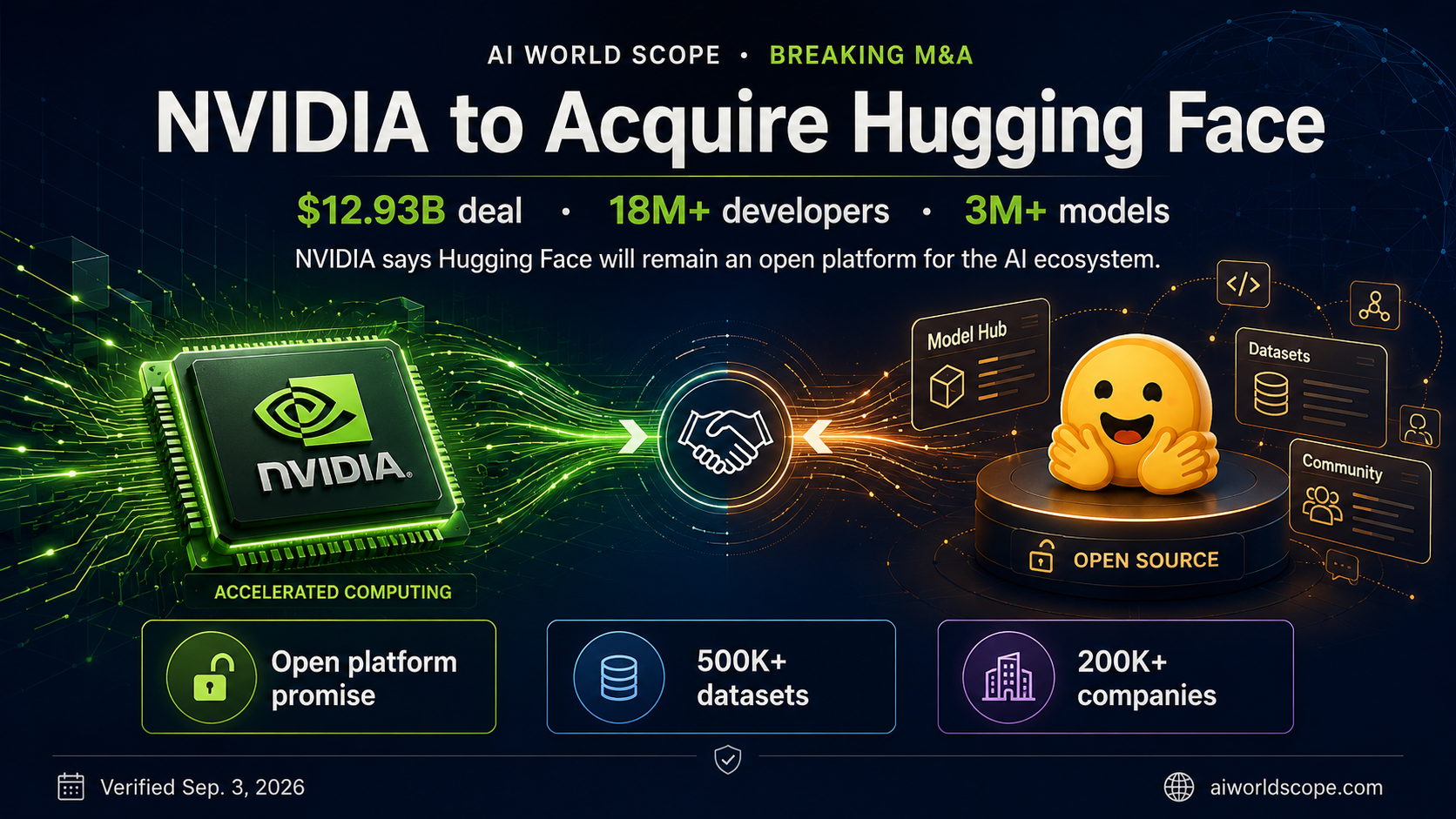
NVIDIA has agreed to acquire Hugging Face for $12.93 billion, promising the model hub will remain open to competing hardware, clouds and models.
Summary
NVIDIA has agreed to acquire Hugging Face in a deal valued at $12.93 billion, bringing one of the AI industry's most important model-sharing and developer platforms under the world's dominant AI chip supplier.
The transaction is not closed yet. NVIDIA's September 3 SEC filing says the definitive agreement was signed on September 2 and is expected to close in the first half of 2027, subject to customary conditions and required regulatory approvals.
NVIDIA CEO Jensen Huang says Hugging Face will remain an open platform where developers can choose their models, frameworks, cloud providers, inference services and computing platforms — and that NVIDIA hardware will not be required to build or deploy through Hugging Face.
That promise is central to the deal. Hugging Face has become a neutral distribution and collaboration layer for a huge part of the open-model ecosystem. NVIDIA is not only buying software and community reach; it is buying a strategic position between model creators, developers, cloud platforms and the hardware used to run AI.
Quick Take
- NVIDIA agreed to acquire Hugging Face for $12.93 billion; closing is expected in the first half of 2027.
- Hugging Face says it serves 18M+ developers, with 3M+ models, 500K datasets and 1M applications.
- NVIDIA says Hugging Face will stay open to non-NVIDIA hardware, clouds, frameworks and models.
- The biggest strategic question is whether Hugging Face can remain credibly neutral after becoming part of NVIDIA.
What NVIDIA is actually buying
Hugging Face is often described as the “GitHub for AI,” but that shorthand undersells its strategic role.
According to NVIDIA, the platform is used by more than 18 million developers, researchers and creators, hosts more than 3 million models, 500,000 datasets and 1 million applications, and is used by more than 200,000 companies.
Those numbers make Hugging Face much more than a model repository. It sits at the intersection of:
- model discovery and distribution
- datasets and evaluation
- developer libraries and tooling
- model demos and applications
- inference and deployment workflows
- enterprise adoption of open and open-weight AI
For NVIDIA, that creates a direct connection to developers before they choose where and how a model will run.
The $12.93B structure matters
NVIDIA's SEC filing gives more detail than the headline price alone.
The deal includes approximately $11.9 billion payable to Hugging Face stockholders, subject to adjustments, plus an equity-based retention program worth up to roughly $1 billion for Hugging Face employees who join NVIDIA.
The company expects the transaction to close in the first half of 2027 after regulatory approvals and other customary conditions.
Hugging Face was valued at about $4.5 billion in its 2023 funding round, according to Reuters. The new headline valuation is therefore close to three times that earlier private-market valuation.
| Deal detail | Current disclosed information |
|---|---|
| Headline value | $12.93B |
| Stockholder consideration | About $11.9B |
| Employee retention program | Up to about $1.0B |
| Agreement signed | September 2, 2026 |
| SEC filing | September 3, 2026 |
| Expected close | First half of 2027 |
| Key condition | Regulatory approvals and customary closing conditions |
Why this deal is strategically bigger than another software acquisition
NVIDIA already dominates the AI infrastructure layer. Hugging Face gives it influence much further up the stack.
A simplified view of the AI market looks like this:
chips → systems → cloud/inference → frameworks → models → developer distribution → applications
NVIDIA is already exceptionally strong at the left side of that chain. Hugging Face is one of the most important neutral meeting points on the right side.
That means the acquisition can help NVIDIA see and support what developers are actually downloading, evaluating, fine-tuning and deploying — while strengthening the path from open models to production infrastructure.
Reuters describes the deal as a bet on the growing demand for open models, especially as companies look for alternatives to expensive proprietary systems.
AI World Scope view: NVIDIA is not just buying another AI company. It is buying a distribution layer that sits between model supply and compute demand.
The neutrality promise is the key issue
NVIDIA has addressed the most obvious concern directly.
Huang says Hugging Face users will continue to choose their own models, frameworks, cloud and inference providers, and computing platforms. NVIDIA says its compute will not be required.
The SEC filing goes further, saying Hugging Face would continue to support other silicon vendors.
That commitment matters because Hugging Face's value depends heavily on trust. Developers use it precisely because it spans competing ecosystems.
The platform needs to remain useful for:
- AMD and Intel hardware
- hyperscale cloud platforms
- Chinese and Western open-weight models
- competing inference providers
- research models that have no NVIDIA-specific relationship
If Hugging Face ever begins to privilege NVIDIA hardware, NVIDIA-hosted inference, or NVIDIA-aligned models in discovery and deployment, its neutrality would weaken.
The acquisition therefore creates a tension: NVIDIA gains strategic control precisely because Hugging Face is valuable as a neutral platform.
Why NVIDIA may want an open-model distribution layer
The acquisition also makes sense as protection against changes in the AI infrastructure market.
Major AI labs and hyperscalers are investing heavily in custom silicon. OpenAI, Google, Amazon, Microsoft and Meta all have incentives to reduce dependence on expensive external accelerators over time.
A thriving open-model ecosystem creates a much broader customer base.
Instead of NVIDIA depending only on a small number of frontier labs ordering enormous GPU clusters, millions of developers and enterprises can generate compute demand across many smaller models, fine-tuning workflows and inference deployments.
Hugging Face can help NVIDIA participate in that demand earlier in the developer decision process.
This is why the deal can be read as both an expansion move and a hedge.
What changes for the open-model ecosystem
Nothing changes immediately while the transaction awaits closing.
But if the deal completes, three areas deserve close attention.
1. Model discovery
Hugging Face rankings, search, recommendations and featured content can materially affect which models developers notice.
Even subtle changes to those systems could create strategic advantages.
2. Inference and deployment
NVIDIA has every incentive to make Hugging Face workloads run exceptionally well on NVIDIA infrastructure.
That is not inherently problematic. The real test will be whether competing accelerators, clouds and inference providers remain first-class options.
3. Data and developer intelligence
Hugging Face's platform offers NVIDIA a uniquely broad view of model popularity, emerging developer workflows and deployment demand.
There is no evidence that NVIDIA plans to misuse that visibility. But the strategic information value of the platform should not be underestimated.
NVIDIA and Hugging Face were already closely connected
This is not a cold acquisition.
NVIDIA says it has published more than 500 open-weight models and 250 datasets on Hugging Face. The companies already work across model distribution and AI infrastructure.
The difference now is ownership.
That changes governance questions even if the day-to-day developer experience initially remains unchanged.
The regulatory question
A deal of this size and strategic importance is likely to receive scrutiny.
NVIDIA is already the dominant supplier of accelerators used for frontier AI training and inference. Hugging Face is a major distribution point for models and AI tooling.
Regulators therefore may examine whether combining infrastructure dominance with a central model-development platform could disadvantage competing silicon vendors, clouds or AI providers.
NVIDIA's explicit commitment to keep the platform open — including support for other silicon vendors — appears designed in part to address that concern.
The transaction still requires regulatory approval before it can close.
What developers should watch
For developers, researchers and AI companies, the practical test will be whether Hugging Face remains as neutral after the deal as it is before it.
Watch for:
- changes in default inference or deployment options
- visibility of models optimized for competing hardware
- pricing or product bundling between Hugging Face and NVIDIA services
- changes to model discovery and ranking
- continued support for non-NVIDIA accelerators
- whether Hugging Face governance becomes more centralized
- any regulatory conditions attached to approval
If those remain broadly neutral, NVIDIA could give Hugging Face substantially more infrastructure and resources without damaging its ecosystem role.
If they do not, developers will have incentives to build or support alternative model hubs.
AI World Scope Take
The headline is $12.93 billion, but the real asset is developer distribution.
NVIDIA already owns a powerful position in AI compute. Hugging Face gives it a route into the layer where developers discover models, evaluate them, download them and decide how to deploy them.
That makes this one of the most strategically significant AI acquisitions of the current cycle.
The deal could strengthen open-model infrastructure by giving Hugging Face more resources, better deployment systems and deeper global reach. It could also concentrate more of the AI stack around a single company.
Both can be true.
The question that will determine whether the acquisition strengthens or weakens the open ecosystem is simple: after NVIDIA owns Hugging Face, will developers still feel that Hugging Face belongs to everyone?
Sources & Documentation
Sources used for this article, with source type and publisher shown where available.
- officialNVIDIA to Acquire Hugging FaceVisit Source
- documentationNVIDIA Form 8-K — Hugging Face acquisition agreementVisit Source
- newsNvidia bets $13 billion on open AI models with Hugging Face dealVisit Source
- newsNvidia confirms it will buy Hugging Face for $12.9 billionVisit Source
- newsNvidia buying artificial intelligence platform Hugging Face for $13 billionVisit Source