China Proposes AI Export Controls, Starts Immediate Registration for Technology Transfers
China proposed controls on 23 AI technologies and immediately required registration for covered cross-border technology transfers, while API access remains outside model-technology export rules.
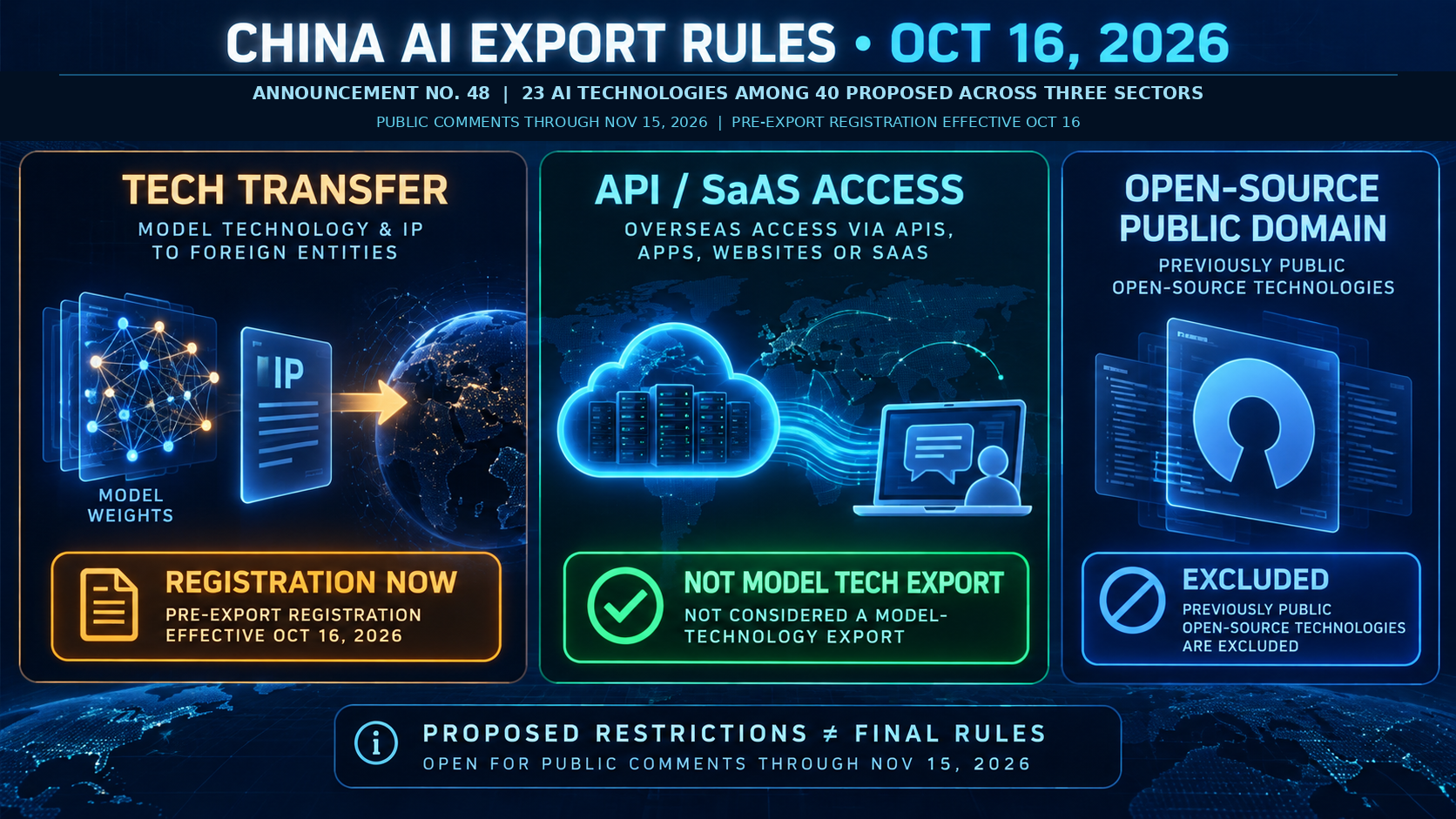
Summary
China's Ministry of Commerce (MOFCOM) and Ministry of Science and Technology proposed adding 23 artificial-intelligence technologies to the country's prohibited-or-restricted technology export catalog on October 16, 2026. The draft covers models, agents, computing clusters, and information processing, within 40 technologies across three sectors.
Temporary pre-export registration took effect October 16 for covered transfers, including unfinished transactions. Proposed bans and restrictions are not final; comments close November 15.
Quick Take
- China proposed export controls covering 23 AI technologies, within a 40-item cross-sector revision.
- Pre-export registration is effective now for covered technology transfers; the proposed catalog changes are not final.
- Previously public open-source technologies are excluded from the proposed scope.
- China's ministry says overseas API, app, website, and SaaS access is not itself a model-technology export.
- Companies transferring weights, IP, or deployment technology abroad face a different compliance question from API customers.
What the government actually announced
MOFCOM and the science ministry issued Announcement No. 48 on October 16. The consultation covers 23 AI-related technologies, five biomedical technologies, and 12 photovoltaic technologies. MOFCOM says the cross-sector package proposes 14 export prohibitions and 26 restrictions—not AI-only totals.
Examples include proposed bans on AI-driven malicious-code generation and proposed restrictions on AI-assisted vulnerability discovery. Exact coverage depends on the annex's technical definitions.
Until the revised catalog takes effect, exporters must register covered transfers via MOFCOM's system, including unfinished exports.
Covered cases include ownership transfers, overseas technology licenses, and changes of control. Registration does not equal a final ban or license approval.
Original analysis: which AI delivery models are affected?
MOFCOM distinguishes technology transfers from hosted service access:
| Cross-border activity | Official position or immediate implication |
|---|---|
| Transfer covered model technology or intellectual property to an overseas entity | Subject to the temporary registration requirement now; proposed final controls may add licensing or prohibition. |
| License covered domestically held technology for overseas use | Listed as a registrable export scenario; review the precise technology and contract. |
| Deploy restricted model technology at an overseas location | MOFCOM says this can count as technology export under the future rules; some overseas-owned-cloud arrangements may qualify for automatic licensing. |
| Serve foreign users through API, app, website, or SaaS | MOFCOM says these routes do not, by themselves, constitute an export of large-model technology. |
| Share technology already in the public domain through open source or academic publication | The announcement excludes already-public technology from the proposed management scope. |
This is a summary, not transaction-specific legal advice.
Original analysis: why this is a major AI policy shift
Unlike chip-focused export debates, this proposal addresses AI know-how and technology transfer. It could affect acquisitions, weight licensing, and overseas infrastructure partnerships while leaving hosted services available.
Hosted API access and transferring weights are different compliance pathways. China has not announced a blanket ban on international AI API access.
MOFCOM promises open-source exclusions and streamlined licensing, but final thresholds and implementation remain uncertain.
What companies should do now
Teams transferring China-origin AI technology should check weights, source code, IP licenses, ownership changes, and overseas deployment against the annex. Review unfinished transactions, document the assessment, and seek qualified advice before a covered transfer.
Hosted API customers are not facing a blanket access ban under this announcement.
What to watch next
After November 15, watch final technical thresholds, licensing procedures, and open-source or overseas-cloud exceptions.
AI World Scope take
Classification: NEW. The defining distinction is that registration is already required for covered transfers, while broader restrictions remain proposed. Companies should respond to the first without treating the second as settled law.
Sources & Documentation
Sources used for this article, with source type and publisher shown where available.
- officialMOFCOM and MOST Announcement No. 48 — Draft Technology Export Catalog and Temporary RegistrationVisit Source
- officialMOFCOM Spokesperson Q&A on Proposed Technology Export ControlsVisit Source
- newsBeijing seeks tighter grip on AI exports amid US rivalryVisit Source
- newsChina moves to curb tech exports, including AI, citing national security risksVisit Source