Anthropic’s Model Hardware Standard Aims to Give AI Agents a Common Interface for Physical Devices
Anthropic’s new Model Hardware Standard is a research-preview specification for connecting AI agents to lab and industrial equipment, with MCP serving as one possible control layer.
Summary
Anthropic has opened a research preview of the Model Hardware Standard (MHS), a shared specification designed to let AI agents discover, understand, and operate programmable physical devices. The first preview is aimed at scientific labs and advanced manufacturers rather than general developers.
MHS is not a new AI model and it is not a replacement for the Model Context Protocol (MCP). The more useful way to think about it is as a hardware abstraction layer: MHS standardizes how equipment describes its capabilities, commands, operating data, and safety limits, while MCP can be one of the mechanisms an AI agent uses to access that hardware.
That distinction matters because the difficult part of “physical AI” is often not model intelligence alone. It is the messy integration work required to make different instruments, robots, and control systems understandable to software.
Quick Take
- MHS proposes a common interface for connecting AI agents to programmable laboratory and industrial equipment.
- It complements MCP rather than replacing it, focusing specifically on hardware capabilities, commands and safety limits.
- The standard remains a research preview and is not yet generally available or open source.
- Its long-term value will depend on independent adoption, governance and robust safeguards for physical operations.
What Anthropic announced
Anthropic introduced MHS on August 27, 2026 as a research preview developed initially with HHMI Janelia Research Campus. The company says the standard can work with any device that has a programmable interface and is designed to be model-agnostic.
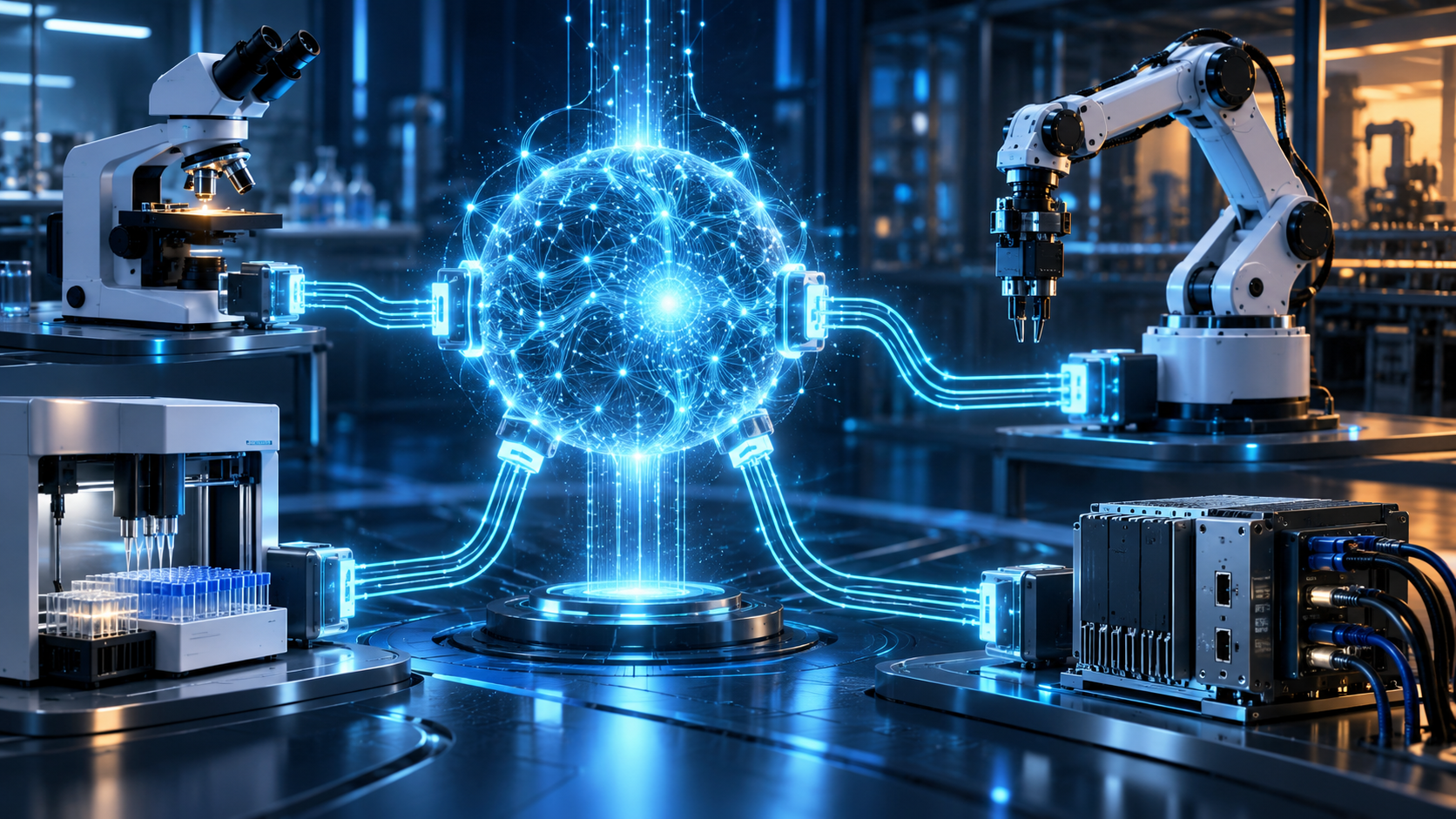
The current preview covers equipment such as microscopes, liquid handlers, robotic arms, and other laboratory or manufacturing systems. Anthropic says early users are testing MHS in areas including drug discovery, laboratory automation, robotics, quality assurance, and instrument troubleshooting.
The standard is not yet generally available or open source. Anthropic says it is sharing an early version with selected partners while it develops safety evaluations and operating best practices ahead of a planned open-source release.
How MHS works
At the center of MHS is a standardized device driver. Instead of requiring an AI system to learn a completely different integration for every machine, the driver exposes a small set of common primitives such as reading a value or writing a setting.
The driver also carries machine-specific information that code alone may not capture: what a device can measure, what can be adjusted, and what limits should be enforced. Anthropic says this metadata can include natural-language descriptions of physical characteristics and safety constraints.
Once devices are described through MHS, an agent can discover them and orchestrate tasks across multiple pieces of equipment. Anthropic describes three control mechanisms in the current design: MCP, a command-line interface, and code files or APIs.
That last point is important. MHS does not require an AI model to reason through every hardware action in real time. For longer or faster operations, an agent can generate deterministic code that chains device commands together, reducing the need for continuous model reasoning during execution.
MHS vs MCP: they solve different layers
MHS and MCP are related, but they are not interchangeable.
| Layer | Model Hardware Standard (MHS) | Model Context Protocol (MCP) |
|---|---|---|
| Primary problem | Standardizing physical-device integration | Standardizing how AI systems connect to tools and data |
| Focus | Hardware capabilities, commands, telemetry, safety limits | Context, resources, tools and external systems |
| Physical-device description | Core part of the standard | Not its primary purpose |
| Agent access | MCP, CLI or code/API mechanisms | Protocol connection between AI applications and external systems |
| Model-specific? | Anthropic says MHS is model-agnostic | MCP is designed as an open protocol |
In practical terms, MHS can describe and normalize the hardware layer, while MCP can act as one bridge between an AI agent and that MHS-enabled environment.
That makes MHS less “MCP for robots” than a complementary layer beneath it.
Why this could matter
The strongest argument for MHS is not that AI suddenly becomes capable of controlling every robot. It is that hardware integration is fragmented.
Labs and factories often use equipment from multiple vendors with different APIs, local software, manuals, and operating assumptions. Anthropic says integrating those systems can take weeks or months. A common driver model could reduce repeated integration work and make hardware more reusable across agent systems.
If that works in practice, three groups stand to benefit most.
Scientific labs could connect instruments into longer autonomous workflows without building a custom AI integration for every device.
Manufacturers and robotics teams could expose equipment through a consistent software layer while keeping device-specific limits in the driver.
AI-agent developers could target one standardized hardware description instead of writing bespoke logic for each machine.
This is also why model-agnostic design matters. If MHS becomes tied to one model family, its value as infrastructure would be limited. Anthropic explicitly says other agent harnesses can use the standard.
The limitations are as important as the promise
MHS is still a research preview, and Anthropic’s own examples show why physical automation needs a higher safety bar than software automation.
The company notes that Claude still has limitations in spatial and physical reasoning. In one example described by Anthropic, researchers had to help the model understand that foaming in biological samples was a physical failure rather than a software problem.
MHS also currently requires hardware with a programmable interface. Devices that cannot be controlled through software need additional driver work or manufacturer support.
There is another important constraint: standardizing access does not prove that an AI agent can safely make every operational decision. A consistent interface can make a device easier to control, but it does not eliminate the need for permission systems, deterministic safeguards, human oversight, validation, and domain-specific safety rules.
For high-risk equipment, those controls may matter more than the agent itself.
What to watch next
The next milestone is not another Claude benchmark. It is whether MHS attracts enough hardware vendors and software platforms to become useful beyond Anthropic’s initial partner group.
Anthropic lists early work with companies and projects including Automata, Doosan Robotics, QIAGEN, Tecan, Universal Robots, Hugging Face’s LeRobot, and Raspberry Pi. The breadth is notable, but partner participation during a preview is not the same as broad ecosystem adoption.
Three signals will matter most:
- Open-source release and governance. Developers will need to see the actual specification, licensing, contribution process, and compatibility model.
- Independent implementations. A real standard becomes more credible when hardware vendors and agent platforms implement it without depending on Anthropic-specific tooling.
- Safety architecture. The specification will need clear patterns for permissions, limits, failure handling, auditability, and human intervention.
AI World Scope take
MHS is interesting because it targets a less glamorous bottleneck in physical AI: integration.
Better models can improve planning and reasoning, but they do not automatically make a microscope, liquid handler, and robot arm speak the same software language. MHS is an attempt to normalize that layer.
The near-term value is therefore likely to be infrastructure rather than autonomy. If the preview develops into an open, widely implemented specification, MHS could make it substantially easier for AI agents to work across heterogeneous physical systems. If adoption remains limited to a small partner ecosystem, it may instead become another useful but vendor-adjacent integration framework.
For now, the right label is exactly the one Anthropic uses: research preview.
Sources & Documentation
Sources used for this article, with source type and publisher shown where available.
- officialPreviewing the Model Hardware StandardVisit Source
- officialIntroducing the Model Context ProtocolVisit Source
- officialHow Claude performs on robotics tasksVisit Source